Sunday, April 29, 2012

Restore


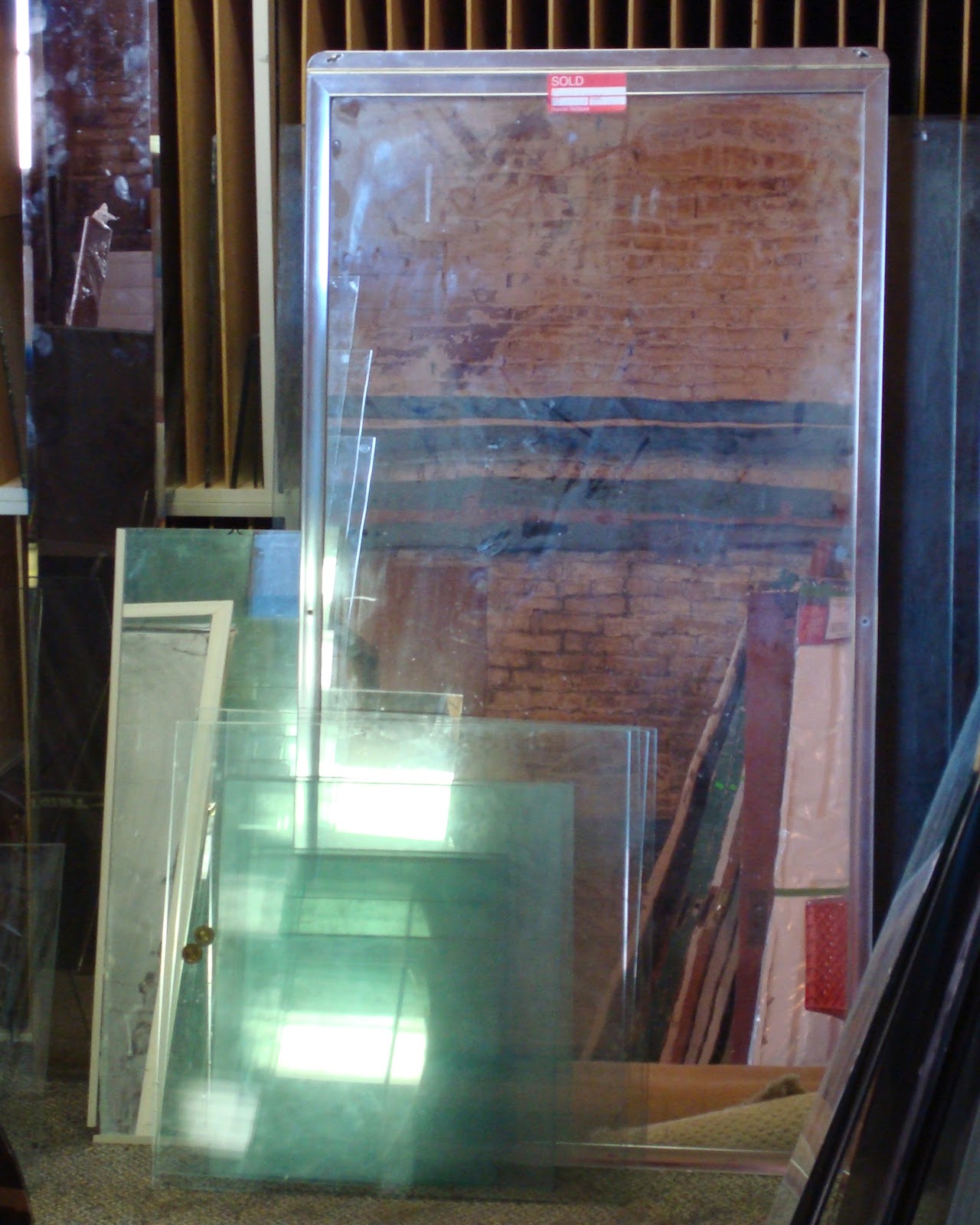
She paces among the dust motes, the old summer doors
with the wood and metalic clap barely echoing
among curtain rods and oak banisters that have come unmoored.
She paces and waits for the wind to sand the sun
free of clouds, for the steadiness of light that streams in
like an annunciation. When it comes
what she sees is how eyes and light conspire
to conjure radiance,
how we become what we see, how the reflection of bricks
makes walls out of windows.
The moment the camera's shutter flicks open
is a meditation on eyes,
how even when we sleep one eye opens inwardly,
how the thick green layers of glass look like the sea's eyes
studying the stillness of its own deeps.
Blood was spilled in the blinding
of Gloucester and Argos,
but it has been assuaged by the families who studied
the green and gold prairie light
through these windows, read the pages of winter,
then lifted each pane carefully down to pile them here.

This photograph was taken by Veronica Geminder at Restore.  Here's how they describe themselves:  "The ReStore sells new and used surplus building supplies (and other donated surprises) to help reduce costs for home owners, landlords, crafters, community groups and artists in Regina. The Restore is committed to solid waste management and diversion from the landfill." All of their profits to go Habitat for Humanity projects.

Veronica's photographs  are inspiring a sequence of poems we are working on for Hagios Press.  The poems are not, technically, instances of ekhrasis, which is essentially the verbal description of a visual object, first created by Homer in his description of Achilles' shield.  Rather, I'm trying to tease out the way they talk to me, they way they have stories implicit in them that I try to find or imagine. Here I'm trying to include the making of the photograph in the poem and to explore the idea of restoration that comes from the site where the photograph was taken.   I love working with them because they completely take me out of myself.

Wednesday, April 25, 2012

Habit

Monday afternoon I began cleaning out the flower beds along my front walk.  The warm air on my skin, the smell and crunch of old leaves, the green fuzz of the enthusiastic flax and the blades of the early bulbs (I don't remember what I planted there!) were like Proust's madeleine.  I wanted to be writing creatively, not struggling to understand Woolf's brilliance, and "nature naturing" (in Kenneth Clark's phrase about the Unicorn Tapestries), along with Facebook updates about people's marking or students' exams made me want to throw in my garden gloves and hit the keyboard.  

Unfortunately, I don't think I'll have much time to work on Soul Weather this summer, though I continue to read and think about the ideas I want to explore in and weave through this novel.  Just last night, sleepless, I was reading a thoughtful piece by Daniel Johnson on the Occupy Regina Facebook page about what they accomplished.  Certainly I can't write about the twenty-something generation and not take this movement into account. His modest goals and gains are inspiring:  if I had to sum up his sense of what they'd accomplished, it was to be a civil presence in our midst that fostered conversations about social justice and questioned our habits of thought.  We were lucky in Regina to have a crew committed to civility, willing to keep their camp drug- and alcohol-free, to be a kind of drop-in centre for the homeless, and to keep Victoria Park a clean, safe place.  Clearly they realized that their behaviour made their voices more credible.  I'll post a link below.

Rather, I need to put all my concentration into my project on Woolf's aesthetics:  there simply isn't any other way to work on this.  Writing about Virginia Woolf is all-consuming.  It isn't like knitting or quilting:  you can't have several other projects on the go as long as you've got space to keep/hide them.  Though the poems inspired by Veronica's photographs are saving my life by giving me something so vivid to respond to.  I spend a large part of every Friday working on them; that day is like a circuit-breaker for me, like a thunderstorm that brings clear fresh weather behind it.  So there are two sides of my mind's life right now:  the daily struggle of wallowing in Woolf's work, being immersed in her diaries and essays, in the criticism, in aesthetics, trying to find a route through the complex, tangled ideas  that a reader can follow.  And writing poems.  So in spite of the chaos of Woolf and renovations, I have a modest habit that saves me.

In fact, I've been thinking quite a bit about habit lately.   I've noticed how much effect unthinking habits have on my quality of life.  I barely play the piano any more.  How did I get out of the habit?  Why can't I get back in the habit?  I've found I do much more knitting and much less quilting than I used to do.  I think I understand this.  Piecing is messy and chaotic.  With renovations going on, I don't need messy and chaotic.  Hand quilting is very zen, but if your mind is spinning, there's nothing else to concentrate on that will slow your mind down the way knitting a complicated sock or shawl will. The big question for me is whether it's easier to break old habits of to create new ones. The experts tell us that it takes six to eight weeks to really create a new habit.


When Marcel travels with his grandmother for a summer by the sea at Balbec, he thinks about habit:  "As a rule it is with our being reduced to a minimum that we live; most of our faculties lie dormant because they can rely on Habit, which knows what there is to be done and has no need of their services....My habits, which were sedentary and not matutinal, for once were missing, and all my faculties came hurrying to take their place, vying with one another in their zeal, rising, each of them, like waves to the same unaccustomed level, from the basest to the most exalted, from breath, appetite, the circulation of my blood to receptivity and imagination" (319).  Taken away from his perhaps over-protective mother and from Paris, Marcel finds himself, as do many of us when we go on holidays, recharged with physical and mental curiosity.


I can see exactly how this would work for Marcel's rather torpid and introspective character, but I find that habit can also liberate, can provide a structure for exploring and taking risks.  My knitting and quilting habits, as long as I haven't fallen into them unthinkingly, provide way stations for thinking quietly, for letting my mind drift around in creative shoals--particularly if I knit or quilt in front of an open window where I'm just vaguely and delightedly aware of a world outside me:  of stories that move by my house in cars, of children trying to walk along the stone wall at the front of my house, of birds with their desires and squirrels with their sense of play.  


Yet I also see around me people who are not quite completely happy because their lives have fallen into certain habits of mind or habits of task that are safe. "Safe" and "happy" aren't necessarily compatible, and nothing is as safe as unconsidered habit.  Habits, like being a workaholic or being a couch potato, can be deadly.  At some level, they're an expression of who we think we are when we aren't thinking about ourselves or about what we really want but don't dare risk seeking.


Scroll down to March 14. There are also a lot of other goodies here. 
http://www.facebook.com/occupyregina 

Tuesday, April 17, 2012

Mrs Dalloway and the Swoopers and Bashers

I'm revising the Mrs Dalloway chapter, so I have a very clean office.

All of you who write will realize that's not really a non sequitor.  Last Friday and  yesterday I gave myself the whole day to work on revising the chapter, and so accomplished lots of other things, sometimes avoiding revising, sometimes doing something stupid (like rearranging two of Bill's jars of change into a jar of nickles and dimes and a jar of pennies for United Way while I put the quarters aside for parking meters) while I tried to think.  I have the structure of the chapter down and most of the evidence is in place.  What I need to do is to think more fully about the significance, the implications of this evidence.  This is both the hardest and the most important work a writer of literary criticism needs to do.  It's also rewarding when you stare at you computer monitor for fifteen minutes, type out two sentences and then tell no one who's listening "Ha!"  In those moments the world suddenly opens out and I have a sense of the role of form in Virginia Woolf's work and a sense of how she wants us to engage with her text and of what puzzles she's left for us to play with.

But continuing in this way is not a very efficient use of time.  I have the extra library books back to the library, the coins sorted,  books returned to colleagues  (sad to say I will not be reading Guy Gavriel Kay during this sabbatical), several rows done on a sock that I keep in my office to knit when I feel panic coming on.  I come home on these days seriously impatient with my lack of discipline and focus.  I can't go on like this, I say to myself, feeling the To the Lighthouse chapter almost ready for drafting.  So today I hit on a new technique.  I read Lighthouse criticism this morning--some of it startlingly good and very helpful in my discussion of Woolf's vision of the autonomous work of art, but not quite on topic--which is the best for me.  After my mid-week lunch with Veronica, I gave myself two hours in my office to revise before going home to hang out with traumatized cats and do more reading.  In two hours I got a lot done and didn't wander the hallways disconsolately or look at a single penny.

Sometimes I think that one of the differences between writers and non-writers isn't some gift for language or profound desire to create literature, but simply the common sense to re-make or rearrange one's writing habits when whatever you're doing isn't working.   How you do this depends on whether you're a swooper or a basher, categories defined by Kurt Vonnegut in Timequake and drawn to my attention by my colleague Craig Melhof.  Here's what Vonnegut says:

Tellers of stories with ink on paper, not that they matter anymore, have been either swoopers or bashers.  Swoopers write a story quickly, higgledy-piggledy, crinkum-crankum, any which way.  Then they go over it again painstakingly, fixing everything that is just plain awful or doesn't work.  Bashers go one sentence at a time, getting it exactly right before they go on to the next one.  When they're done they're done.  I am a basher.  Most men are bashers, and most women are swoopers.  Again:  Somebody should look into this. 

I find his assignment of gender interesting.  On one hand, he's right:  I'm a woman and I'm a swooper.  I need the larger shape of an argment or a plot to ground me.  It's a bit like Leonardo sketching a cartoon of a painting he wants to make--though that's just a simile, not my claim to genius.  Then when I know what the bigger argument is all about, I'm happy to tinker, tinker, tinker, playing with wording, creating an emphasis here, an echo there, fleshing out a summary to create a scene or reducing a lengthy scene into a brief summary.  I have a mantra:  the larger, grander idea I want everything to be suspended from in the most elegant and natural  and light-hearted way possible. 

But my daughter Veronica is a basher.  Everything she writes is so densely inter-woven that she feels she can only build from the firm foundation of everything that's gone before.  Here's the real difference between bashers and swoopers that I see:  I have a hunch, an intuition.  I've looked at the evidence or thought long and hard about my characters and my idea, and I'm willing to fly off on a wing and a prayer.  It's only a draft, after all.  A draft is just something you can make better.  Veronica, in contrast, is very linear.  Hunches aren't worth much (not even that whole JAR of pennies) in her writing universe.   

Writing this, I realize that there are some times when I bash:  when I'm writing poetry.  Then I've got a prompt--a vision, one of Veronica's photographs, half a sentence I overheard someone utter--and I have to figure out what it means, what its significance is.  I bash off a little kernel, trying to get every word right and to see where those words want to go.  Then I bash off a little more around the edges to see where its balance point is, its centre of gravity.  Then more careful bashing and re-bashing.

So here's this week's quandary:  are you a basher or a swooper?  Is Vonnegut mostly right about gender?  Does your decision to bash or swoop depend on what you're writing?  I'll be teaching nonfiction in the fall, so fill me in on all the various bashing and swooping you do so I can help my students find their own useful method.

Thursday, April 12, 2012

Renovations and Parents: Paring back even more


I talked to my oldest friend, Liz, who has known me since I was twenty, on Sunday night.  It was my much-belated birthday phone call.  Her father, with whom she is very close, has had a stroke that has left him with little ability to create new short-term memories (like the fact that he shouldn't get out of bed without his walker) and some worrying holes in his long-term memory:  he still believes that his parents are alive, although he recognizes the assisted-living facility where he lives.  Liz understandably feels unmoored, given the suddenness of the stroke and the way she'd depended on her father's presence.  I tried to explain how our parents stay with us even when they die, but that didn't resonate with her, given her circumstances.

Right after my mother's death, I found myself left with her expressions, many of which were Janus-faced--optimistic and funny as well as dark and angry.  But after several months, I found that both my parents had become presences in my life that exceeded in many ways their place over the last ten years or so.  Veronica suggested that I'm not thinking of them through the glass of concern or worry or loss that dominated the ends of their lives.  While the insight is Veronica's, the metaphor is mine:  it's as if there was a dirty window or a mud-and-bug-strewn windshield between us.  Once the worry was gone--once I stopped thinking about how we were going to get Mother calmed down to go to the doctor for one of the endless UTIs, or figure out how we were going to get Dad to eat, I could see them more clearly.  Now there's a new metaphor:  it's as if I look through a glass-bottomed boat almost daily, seeing memories through clear water as they float up into my experience and my consciousness.

Earlier this week, we finished clearing out the kitchen for the renovation; the destruction is supposed to start this morning.  I had cleaned out the buffet and the china cabinet in February to move them when the floors were done, and had purposefully not put anything back in them.  Now they are my very minimal kitchen cupboards.  I've taken my library of cookbooks off the shelf underneath the microsave so it can hold the ingredients I use daily--the olive oil, the rice wine vinegar, the cinnamon and baking powder.  I've cleaned out drawers I hadn't looked at for twenty years.  The paring back feels good. 

But mostly I've been thinking about my mother.  Unlike her Janus-faced expressions that echoed her view of the world--she was often depressed, but could also be enraptured by joy, curiousity, and wonder--her ability to improvise struck a single note.  The need to improvise brought out her creativity and her pride in inventiveness combined with practicality. 

My father was a TV repairman who was always the last person in Grand Rapids Michigan to raise his service call rates, so we lived on the edge of respectable poverty punctuated by what my mother saw as the necessities of life:  trips to the library and symphony tickets.  Travel was one of those necessities, part of our education.  We went on vacations every year, the range of our travel determined by the family economy.  But we never ate out.  We had a Coleman stove, a water cooler, a large cooler and a picnic basket.  Somehow my mother made three meals a day, often including a cooked breakfast (though we also loved the little boxes of cereal that were their own bowl) out of whole cloth.  I don't remember grocery shopping:  it was as if a whole week's necessities grew in the picnic basket and the cooler every night over night.  Small toys to amuse a bored daughter magically appeared out from under the front seat of the car.  Sometimes, in desperation, she paid me twenty-five cents an hour not to talk, though I could write notes.  But except for her amused desperation at being locked in a car with Chatty Kathy, I don't remember her ever losing her cool.  Making it up as she went along seemed to suit her during those times.

My mother's unlikely gift to me at this moment is a sense of playfulness, of improvisation.  I probably made my last bread for a while on Easter weekend, but I don't see any reason I can't make fruit crisp or almond bars while we're under construction. Last night be had pork tenderloin with balsemic cranberry sauce; on Friday I'm making Morocan chicken pie.  I'll make it up as I go along, which, when you think about it, is a joyful, optimistic approach to life. 

Monday, April 9, 2012

Days to retreat and reflect: paring back


The Mrs Dalloway chapter is done, coming in at a cool 40 pages.  I will leave it for a week while I read Woolf's diaries for the next few years, read the criticism of To the Lighthouse, and then re-read that perfect novel again.  In the meantime, I have to work up my courage to write, something the Dalloway chapter seemed to steal.  In its place, it has left what I have come to call "The Dalloway Headache."


So I had a plan for the long weekend, which the weather initially conspired to help me keep.  First, I made my Cardamom Bunnies, which somehow get made every year, regardless of how many chapters I need to write or how many essays I need to mark.  The comfort of kneading warm bread dough and the smell of cardamom in my kitchen seemed like a plausible antidote to "the Dalloway headache" and the fear of writing.  Bill and Veronica enjoyed the rabbits, but the headache stayed put.


On the windy, wet Good Friday, I turned to music. I am not at all religious, but I always mark the major Christian holidays with music, perhaps because I believe that these festivals have become part of what makes us human, and it is art that captures that humanity for me.  So I have listened to Bach's St. Matthew Passion with its extraordinarily calm depiction of suffering.  Through many of the movements there is a motif in the bases, a kind of tum-TUM that sounds like the beating of a heart.  Friday I listened to Verdi's Requiem.  During the magnificent and martial "Dies Irae"--Wrath of God--I couldn't quite say why it moved me so.  If I do believe in God, it isn't the angry deity of the Hebrew texts, but some curious and yet indifferent creative force who has made a magical world and people with consciousness (think how magical that is) and said "You've got all you need to thrive.  Let's see what you do with it."  Sheba undercut the fury of the Dies Irae even more by sitting on my lap and stretching one of her white paws toward my throat.  I called Veronica, who was listening to Arvo Part, to ask why we do this every spring:  listen to the sacred music of the season.  "We need to remember that people suffer and to pay attention to that suffering.  This seems like as good a time as any," was her wise response.  Sheba was deliciously unaware of any suffering.


On Saturday, we had our usual routines of morning coffee and grocery shopping.  And of course, we admired the thick sticky snow but not the northwest wind that had  fixed it to tree trunks and fences.  I settled down to read a biography of Thoreau.  Veronica and I, after our "debut" with my poems and her photographs at the Humanities Research Institute celebration of Ken Probert's life and its effect on the writing community, have committed ourself to do a book of poems and photographs.  I so love the way the photographs take me out of myself, challenging the practice of "confessional poetry" that began in 1959 with the publication of Robert Lowell's Life Studies.  Veronica's photographs are distinctly, relentlessly urban, though she's got some beautiful black and whites of Walden Pond.  While we were there, we saw the reconstruction of Thoreau's cabin.  It has everything a writer needs:  bed, chair, table, bookshelf, and stove.  One of his mottos, which I've got on a postcard somewhere, is "Simplify! Simplify!"  I'd like to end our book of photographs and poems there.

Yet Robert Richardson's biography of Thoreau makes it clear how complicated it was to simplify.  I hadn't realized how rich and complex was the philosophical tradition that led to Thoreau's lifestyle; certainly I didn't know about its German roots in Goethe's concept of Bildung.  Here is Bruford on the German idea of self-cultivation:  "The inwardness, the culture (bildung) of a German implies introspectiveness; and individualistic cultural conscience; consideration for the careful tending, the shaping, deepening, and perfecting of one's own personality."  This describes, I suppose, what we all need to do: self-reflect and learn from what we observes of ourselves.  It's a perfect prompt for a cold windy Easter weekend.  It also appealed to the Dalloway headache:  surely I could self-improve my way out of this?

Sunday I began by cooking.  I'm not much good anymore, as you know, at multi-tasking in the kitchen, so I tried to get as much done well in advance as I could.  I started to make bread only to discover that I was nearly out of white flour.  As a result of my alarm, I forgot to put in the salt.  Next was a lemon meringue pie--simple enough, I thought.  But it turns out I don't really know how to make lenon meringue pie:  I had no idea that you baked the meringue; my mother always broiled it.  More alarm.  Will this work?  The Dalloway headache had a field day with my cooking, enjoying especially the fact that half my tools are in the basement.  But Bill and I had a lovely evening with Veronica and Jenny.  Bless him, Bill did the dishes while I sat with my young knitters and marvelled at what they accomplish with two sticks (sometimes 5).

This morning, the Dalloway headache is a faint presence, but it seems to have taken with it any sense that I could tend or perfect my inward personality.  What inwardness?  I doubt this is what Thoreau thought of when he exhorted his fellows to "Simplify!"  There is sunshine.  There are cats who were grateful when I got up at 6 to feed them and then cuddled while I knitted.  Perhaps inwardness--thinking about why the Dies Irae moves you--is over-rated?  Or perhaps inwardness needs a clean slate once in a while.

Friday, March 30, 2012

Renovations, revisions, and a drive to Moose Jaw

We don't yet have a date for the kitchen destruction, but my skillful cabinet maker came on Wednesday to take a careful look at the room and firm up some of the plans.  In the meantime, I've been cleaning out drawers and cupboards, thinking about what is really necessary for the kind of cooking I do now.  There's a kind of archeology to this process:  as I dig into the back of drawers, I fetch up things like an avocado green hard-boiled egg slicer or the baby silverware or four differently-sized whisks. (I was looking for the perfect whisk, I suspect.)  I moved my kitchen into this house in 1990, when Veronica was 11, and haven't really cleaned out drawers since, though my cooking has changed dramatically.  There's now a box downstairs with items that will go to Community Living or some similar charity.  I'll leave them in the box, which I can get to easily in case I need something; but a month after reno, out they go.  If I haven't used them by then, I don't need them.  Even before the new kitchen is created, I have more space.

I have good feelings about revisions like this one.  Twice in my life, revision made an enormous difference.  There's the funny story:  about how I had posted a provile on LavaLife, (before it got cheesy) but wasn't getting much interest.  A close friend was dying, and the portrait of myself that I'd created was of someone facing a friend's mortality, facing the unfairness of a universe that took a friend in the prime of her life.  Serious.  No sense of play.  I no longer remember what inspired me, but one morning I rewrote my profile, making it much more playful and flirtatious.  Bill got in touch the next day; we met a week later after a series of insightful emails; I set a land speed record for falling in love.  I have actually shared this story with students in writing classes with the following moral: It always pays to revise.

Then there's the startling story.  When my insightful publisher, Ruth Linka, read the edited draft of Blue Duets, she said quite firmly "This ms is 120,000 words long.  You've got to get it down to 90,000."  She had two reasons for this.  One was simply that Blue Duets was a first novel and you can't sell first novels if they cost more than $20.  The second was aesthetic.  The novel tells a fairly small story--small in the context of books about wars, about injustice, about massive cruelty, about historical figures.  The manuscript, on the other hand, was bloated.

You have no idea how liberating it was to undertake that revision.  I had to decide what was important and to shave or sand away everything else.  If the novel has a coherent shape, it's because Ruth insisted on that revision.  If the reader clearly knows what's important, if she or he connects emotionally to Lila's experience, it's because there is less dross, fewer red herrings and false turnings.  When you find the right shape for a story, you can quit talking about it and let the story be the reader's guide.

This morning, I hit the road for Moose Jaw.  That's a non-sequitur if you've ever heard one.  But I'd gotten to the point in the chapter on Mrs Dalloway where I can't see the chapter's shape, where I'd lost the thread of its purpose. 

There are two elements to revising.  One is to literally re-see or re-view what you have made.  This part of the process forces you to take the long view, to step back and study the way the various pieces fit together, to see whether they're running alongside an elegant fence or simply held together, cruelly and crudely, with baling wire.  The second element brings you much closer to what you're written to see if the paragraphs hold together and have a coherent structure, if your mechanics are solid and keep the reader's confusion to a minimum.  Hence the need to drive to Moose Jaw.  On the road, I can't flip my pages back and forth defensively to tie up the bits of string that seem to be straggling between the pages.  If I can't recall the major steps in my argument while I study the prairie, I'm in trouble.  There's something about that huge landscape that makes one take the long view, the large view.  So I found where I'd gone awry and figured out where the next pieces of my argument should take me.

At the same time, driving to Moose Jaw at this time of year, when the landscape is as minimal as my kitchen drawers, makes you attend to detail.  Is that a hawk?  Are there birds in those nests?  Do I really see buds on these trees?  So you come back ready to do the other kind of revision, the less inspiring but nevertheless satisfying work of getting all the details in place. 

I like both elements of revision.  The large-scale version is a cheeky girl who's looking at you archly and saying "So?  So what?"  The smaller-scale version is a youthful engineer who is convinced everything will work better if all the pieces and screws and washers are in their right place.  If that machine is your stove or your sewing machine or your computer, you also value efficiency, tidiness, and a sense of purpose.  So of course you want your writer or your artist to make that thought as clear as possible so you are ready to grapple with the demands it's going to make of you to think in a new or different way.  Then it's your turn to hold the piece of writing or the work of art up to the world you see to see if you, too, need to revise.  The drive from Regina to Moose Jaw takes just the right amount of time for doing that.

Friday, March 23, 2012

Ken Probert: Our libraries, ourselves

On Wednesday I met with Bruce and Kathy Probert, Ken's brother and sister-in-law, to consider what might best be done with Ken's enormous and varied library.  We took the green tea Kathy had made and wandered the rooms upstairs, where the books were all hugger-mugger, some of them in large blue bins--perhaps moved from his office and sadly never unpacked.  There was one bookshelf devoted to beautiful books--a Folio Society slip-cased edition of Trollope's novels and a beautiful boxed set of Jane Austen; Grimm's complete Fairy Tales next to two lovely volumes of Sherlock Holmes.  He had a number of titles from McSweeney's publishing house, each put together in a way that playfully challenged what the book could be.  Part of the portrait that emerged here was that of a man who loved the beauty of books, who felt their seductions and satisfactions.
 
What an interesting portrait of a man who read Foucault and Freud, but who was interested in New Yorker covers and Edith Wharton's decorating style.  Books on slavery, the result of Ken's interest in nineteenth-century American literature, nudged books on World War I.  He wasn't simply interested in other places, though the Saskatchewan Encyclopedia had lost touch with Saskatchewan geography and history, so we did some sorting.  There was one island of order in all this:  Ken's set of Library of America editions, which will be a significant addition to the University of Regina Archer Library.  We never found, though, copies of the books he edited, Writing Saskatchewan, and Writing Addiction.  Ken's humility was clearly in overdrive.

Fortified by Kathy's tasty cookies which have healthy seeds and decadent chocolate chips, we went downstairs.  The "family room" had built-in bookshelves, and as I stood in front of them I suspected I could see the young Ken Probert organizing his intellectual passions as he filled the first bookshelves in his house.  There were all of G.B. Shaw's plays; a set of "complete poems" from all the important nineteenth-century Romantic poets (and a bit beyond):  Wordsworth, Coleridge, Byron, Tennyson; three lovely volumes of Yeats. His more recent enthusiasms had built up in the spaces between, where Alice Munro was evident.

As I stood back to attempt to get a view of this wall as a whole, I suddenly found my memory inhabiting Buswell Street in Boston's Back Bay.  My first husband Dan and I had moved into Boston University married housing, while he worked on his Master's degree in music.  For three or four weeks, my own books remained in boxes:  can you imagine that university housing had no bookshelves?  I became, frankly, more and more depressed as I took buses to and from Brandeis University where I typed up (and slyly corrected) the writing of a group of social scientists.  (People caught on to my furtive improvement of their work and were pleased, though I do remember one very tall fellow looking at typed-up copy, reading the first page, and exclaiming "Did I write that?  Wow!"  I didn't enlighten him.)  I needed to have my books out, I told Dan miserably.  That weekend we headed to the nearest lumber yard where we bought the wood for bookshelves that my daughter Veronica continues to use.  Ken's boxed set of Austen will be happy there.

But as my mind conflated this memory with the books before me, I thought about our relationship to books.  First, how hopeful they are, how they speak to us of hope and adventure as we imagine reading them.  How they speak of our willingness to go to places deeply unfamiliar as well as half-known.  Even if some of the titles on our shelves are only there because we think they should be, they speak of better, deeper, wiser selves we hope to become.  (Until this year, Remembrance of Lost Things has filled that space on my bookshelves.)  How we organize them tells something about us.  Are they alphabetical, speaking of our penchant for order?  Do we have the beautiful books at eye level, the orange Penguin paperbacks down near the floor?  Do we fancy our high-falutin taste for European literature, and give them place of prominence?  Have we kept our Hesse?  Do we claim solidarity with the guys and set Cormack McCarthy next to Hemingway or show our support of women by putting Marge Piercy and Doris Lessing next to George Eliot and Margaret Drabble?  Do we slip in a little chick lit to prove we're not snobs?  Maybe The Jane Austen Book Club?  (I have a copy that Ken gave me.  He was my snob detector.)

Interestingly, the fiction was on shelves in another corner of the room:  most of the important British and American and Canadian fiction of the nineteenth- and twentieth-centuries, all thumbed and annotated.  Any of us who have inherited Ken's well-read books can speak to what an intelligent, uncanny reader he was.

After we'd packed up some books I thought my colleagues would value--Helen Vendler on the Sonnet for Jeanne Shami, and Emily Dickinson and Edith Wharton for Cindy MacKenzie--the three of us stood in the hallway, a bit overwhelmed.  It had been in many ways a plangent and congenial afternoon thinking about Ken.  (Though I have to say that Ken has called me more than once on my love of that word "plangent.") As you will know, I simply had to bring up Virginia Woolf, particularly Mrs Dalloway, and this passage from the beginning of the novel, where Clarissa is walking across London to choose the flowers for her party:

Did it matter then, she asked herself, walking towards Bond Street, did it matter that she must inevitably cease completely; all this must go on without her; did she resent it; or did it not become consoling to believe that death ended absolutely? but that somehow in the streets of London, on the ebb and flow of things, here, there, she survived, Peter survived, lived in each other, she being part, she was positive, of the trees at home; of the house there, ugly rambling all to bits and pieces as it was; part of people she had never met; being laid out like a mist between the people she knew best, who lifted her on their branches as she had seen the trees lift the mist, but it spread ever so far, her life, herself.  (8)

"That's what we're doing with Ken's books," I told them.  "We're sending him out into the world."


Monday, March 19, 2012

Simplicity


At my age (sixty-two on Saturday), I find myself drawn to snippets in the media that consider the lives of seniors.  I note with some comfort that it's been decided that older folks' reaction times aren't really slower:  we simply choose to reflect for a moment before firing across the bow.  Even more comforting is the fact that older people are happier than their younger counterparts--this in spite of the fact that I have three seriously dedicated curmudgeons in my neighbourhood who provide daily examples of dissatisfaction, frustration, and even anger.  Apparently there are two reasons for our optimism and cheerfulness.  One is that we have more fully-developed coping mechanisms.  The second is perhaps (the scientists don't say this in so many words) that our apprehension of our mortality and our sense of history have conspired to teach us what's important. 

I'm finding that my sabbatical, in giving me time out of the fray of institutional and personal politics, battles for power and recognition (some very covert, but pervasive and poisonous nevertheless), time out from the necessity of multi-tasking and being constantly interrupted, has honed my sense of and whetted my appetite for what's important.  For the most part, this lies in simple, solitary things:  Sheba settling down next to my computer to purr while my thoughts about Woolf come with a richness and ease I couldn't have imagined.  (Believe me, this doesn't happen every day.  Right now, I'm avoiding writing the introduction to the Dalloway chapter by writing this blog post instead.)  Hearing my first robin on Saturday, kneading bread, knitting complicated lace or piecing quilts, reading Anna Akhmatove's poetry, arguing with Bill about the way movies reflect and influence our sense of what the world is like--these things are important. 

Reading Woolf, galloping ecstatically through Mrs Dalloway has had no small part in this hunger, for what she manages to do with her beautiful language and trenchant use of form is to remind us that experience is what matters, not money or power.  At the beginning of her eponymous novel, Mrs Dalloway thinks "In people's eyes, in the swing, tramp, and trudge; in the bellow and the uproar; the carriages, motor cars, omnibuses, vans, sandwich men shuffling and swinging; brass bands; barrel organs; in the triumph and the jingle and the strange high singing of some aeroplane overhead was what she loved; life; London; this moment of June" (4).  Lily Briscoe, toward the end of To the Lighthouse, as she works on her painting, observes that "One must keep on looking without for a second relaxing the intensity of emotion, the determination not to be put off, not to be bamboozled.  One must hold the scene--so--in a vice and let nothing come in and spoil it.  One wanted, she thought, dipping her brush deliberately, to be on a level with ordinary experience, to feel simply that's a chair, that's a table, and yet at the same time, It's a miracle, it's an ecstasy" (272).  Certainly Woolf gives us a kind of Buddhist advice to be in the moment, but with her language, the ecstasy of her sentence structure, the varieties of unique and everyday experience--brass bands and utilitarian chairs, she harnesses and directs our attention imaginatively.  It's all very well to be in the moment; what's important and life-saving is to recognize how complex, contradictory, chaotic, and miraculous the facets of that moment can be. 

Mrs Dalloway realizes how important it is to be grateful for all those people who make her magical life possible; in the same vein, let me thank all of you who sent birthday greetings, some of these coming from former students who are now far away, and whose words create the web of connections that is at the centre of Mrs Dalloway.  But it was Bill, Veronica, the weather, Golden Willow and the BBC's "Through the Night" radio program that gives you six hours of surprising music that made my day rich and peaceful. 

I've said that seniors have been taught by history and mortality to realize what's important.  I think our expectations change as well.  As we pack up for the various renovations to our house, I'm finding myself throwing out (or sending to Value Village) quite a few things I feel I no longer need, and putting things back in rooms slowly. I don't want to simply recreate the old living room and dining room, except for a beautiferous floor.  I want to put up the artwork that still moves or fascinates me, to put out the ceramics that seem to me to question what pottery can be.  I want a simplicity that lets me see each thing fully.  In the same vein, I have come to love simple birthdays.  Bill's gift (besides a wonderful meal at the Creek Bistro) was, as requested, a donation to BecauseIamagirl, a U.K. charity that focuses on girls' health, education, and well-being.  Veronica made me a pair of socks.

A pair of socks?  How underwhelming for a sixty-second birthday, you say?  Absolutely not.  These are "Crazy Samurai Zaubersocks."  I can see her choosing the Zauberball that leads off my post, thinking that these are her mother's colours.  Then she found the perfect pattern for them (which you can't really see in her photograph) from a book of Japanese knitting.  Then she improved on the pattern, which stopped at the ankle, with a lovely little cable which goes all the way down the foot.  Then serendipity loaned its delight.  Zauberballs have stripes of colour, but they seem not to repeat in a predictable way, so you can't make two identical socks.  Off-kilter socks for her off-kilter mother!  Perfect.

Simplicity, whether in your mind or your interior decoration, gives you time to think about what goes into your conversations with your husband or your daughter's planning (not to mention three weeks of knitting) of the perfect pair of socks.  Such simplicity needs time, however.  I'm worried that I will lose these quiet moments of knitting and music and reflection that deepen experience when I get back from sabbatical.  But maybe my off-kilter socks will remind me to be off-kilter and to take advantage of the disguise of a curmudgeon  to decline serving on some committees and to break off a mean-spirited or gossipy conversation, to spend time with the people and animals and thoughts that I love. 

Thursday, March 15, 2012

Building a Flexible Democracy


Today Katherine Arbuthnott and I were having our Thursday morning breakfast together at Tangerine at the bracing hour of 7:30.  (We've done this four Thursday mornings in a row, so I suspect that constitutes a tradition in the twenty-first century.)  But Tangerine has deadly scones and great jazz, and Katherine and I have conversations that range from children and grandchildren to saving the world from itself, so stealing time early on Thursday is definitely worth it.  We were laughing about women who buy the latest anti-wrinkle cream or the lotion that makes your skin luminous.  We weren't laughing at them, you understand.  We were laughing at this example of what economists call "sunk costs."  You've done it:  invested in something you can tell isn't working and then invested in even more in it, just in case you're not using enough cream or drinking enough water with echinacea or giving that deadbeat lover enough of a chance.  You've invested more in a losing strategy just to prove you're not a complete fool.  Here's how Katherine describes it in a paper she's working on:

"The term 'sunk cost' refers to previous investments that are irretrievable, but have no influence on future outcomes.  Thus, consideration of such past costs for future investments violates the principles of rational decision-making.  This is a reasoning error because we cannot change the past (e.g., recover spent resources), but we can make better or worse decisions about future strategies, independent of our past decisions or mistakes."

After we got through laughing about the useless cream and the even more useless lover, we considered what this theory tells us about how we're responding to climate change.  Because building a Keystone XL Pipeline or a Northern Gateway Project  is sunk cost with a vengeance.  Yes, fossil fuels have made possible the culture and technology that heats and lights our homes and keeps us in contact with farflung friends and even organizes uprisings against dictators.  But first, we know that supply is limited.  Second, we know that we're overheating the planet and destroying habitats and plant and animal species.  So why aren't our leaders (sorry:  you've heard me harp on this before) changing directions and putting money behind solar or geothermal sources of energy?

It turns out there are reasons why we pursue losing policies, reasons that public opinion--yours--might do something about.  First, leaders are severely criticized for changing their minds.  We don't see this as a rational shift brought about by better and newer data.  It's waffling.  But surely at a time when change is occurring so fast that few of us can keep up (how many of you have updated your Facebook home page and embraced the new format?), changing your mind might be a virtue.  If we praise these changes, say about the decision not to spend billions on fighter jets, we might make it easier for leaders to reconsider their policies and their choices.

Second, even when we're given good information about choices, we almost always see the information about the choice we've been inclined to make as better than information that contradicts our past decisions.  So we need to build into our decision-making committees and our governments room for the devil's advocate who can call us on that bias.  We might have called that advocate "Her Majesty's Loyal Opposition" (as an American, I love that phrase), except that they seem to be understandably in disarray right now.  But maybe we can inject the virtues of the devil's advocates in our conversations over the next three years or so and help Her Majesty's Loyal Opposition see the honour in and importance of that role.  We all need a reality check:  that's why I've got wise people like Bill and Veronica and Katherine in my life.  It's perfectly honourable to embrace people who tell you occasionally that...you get my drift.  So let's make it honourable and functional in politics and in other groups that undertake important decisions.

I came home from breakfast to my other task for the day:  to write the introduction to my chapter on Mrs Dalloway.  That accomplished,  I took myself off for a glorious walk on the creek bank.  I joined the world of dog people, including one young man who wanted to tell me about his 9-week-old Brittany Spaniel who nibbled my fingers, and whippet who put her sleek, elegant head into my outstretched hands.  Am I a dog person in a cat person's body or a cat person in a dog person's body?  I noticed that at the Robinson Street Bridge willow leaves fell after the ice formed and now the ice around them is melting more quickly, so it looks like the creek is full of tiny, flashing 3-D fish. I overheard snippets of conversations about someone's instability and the tea towels that were in the box along with....  I know, I know, having this walk on the 15th of March is gloriously abnormal.  But the warm weather isn't a nice side-effect of climate change; it's caused by a shift in the polar jet stream.  The lack of snow and the grass fires are a worrisome result of the kinds of fluctuations in precipitation patterns we can expect.

So, besides your own secret story of sunk costs, you've got a story about what happens when we get out of our houses and our cars and are living in the world, on the earth and in the mud and breeze again.  That experience is worth saving.  So let's get busy and talk about ways we and our leaders can honourably change our minds and embrace our inner devil's advocate.

Thursday, March 8, 2012

The Ethics of the Imagination: Virginia Woolf (again)

In 1976, when I finished the coursework for my Master's Degree at the University of Michigan, I had a day to wander Ann Arbor (and Ann Arbor's book stores) before I packed myself up and returned to Winnipeg, where I was living at the time.  I felt strangely grown up, partly because taking courses at the University of Michigan during three consecutive summers was intellectually exhausting, and because I was going to start a Ph.D. at the University of Manitoba in the fall.  But there was also something about the lush, verdant Ann Arbor summer; my sense that my marriage was in trouble; a married man with a wonderful voice who had found me attractive (but neither of us would or could do anything about it); and a desperation to figure out what I could do besides return home.  People with an M.A. in English have no obvious job skills (it was even less obvious then than it is now), so I bought a book:  Max Frisch's Sketchbook 1966-1971.  I was attracted to the entirely different kind of reading that this would be, to the idea of being inside a writer's head, to the idea of European sophistication that seemed so unlike my entirely existential uncertainty.  One of the first entries contained this question at the bottom of the page:  "If you believe strongly in an idea, would you be willing to impose it on other people?"  There was a strategic page turn while you contemplated this question.  At the top of the next page, Frisch asked "Why not, if you are right?"

That question has bothered me for years, but was only answered by the work I am now doing on Virginia Woolf's Mrs Dalloway.  Here is Woolf's diary entry for 27 August 1918, but completed three days later:

"Now I confess that I have half forgotten what I meant to say about the German prisoners; Milton & life.  I think it was that    ?  (all I can remember now (Friday August 30th) is that the existence of life in another human being is as difficult to realise as a play of Shakespeare when the book is shut.  This occurred to me when I saw Adrian [Woolf's younger brother] talking to the tall German prisoner.  By all rights they should have been killing each other.  The reason why it is easy to kill another person must be that one's imagination is too sluggish to conceive what his life means to him--the infinite possibilities of a succession of days which are furled in him, & have already been spent"  (Diary 1 186). 

Use your imagination to put that entry beside one way of looking at Mrs Dalloway.  While the novel's characters have a range of ways of seeing and understanding the complexity of other people, Woolf illustrates two extremes.  One belongs to what I call the fundamentalists, people who know they're right, people who have taken a body of knowledge or belief, like psychology or Christianity, and turned it into certainty, judgmental, destructive people like Miss Killman and Dr. Bradshaw.  Then there are people like Clarissa who can imagine the integrity and the experience of others.  It would take me paragraphs and paragraphs to give you the subtle evidence of Clarissa's view of others, but let me simply offer a synecdoche and a single example.  For Clarissa, who looks frequently out of a window and glimpses the old woman living in the house next door, the notion that "here is one room; there another" is one of life's mysteries and miracles.  Those rooms stand, I think, for the individual's integrity which wraps them round like a shell or a room.  We should no more break into that integrity by telling them "that they were this or were that" (7) than we would break into their house.  Clarissa can also imagine the suicide of a young man she's never met, a suicide that's talked about at her party:  "Always her body went through it, when she was told, first, suddenly, of an accident:  her dress flamed, her body burnt.  He had thrown himself from a window.  Up had flashed the ground; through him, blundering, bruising, went the rusty spikes.  There he lay with a thud, thud, thud in his brain, and then a suffocation of blackness.  So she saw it.  But why had he done it?"  (156).

It's no accident that Woolf couples Milton or Shakespeare and life and German prisoners.  Milton urges us to understand Satan, to see both his hubris and his charisma.  Current research is leading psychologists to understand that a process they call "deep reading," which is essentially getting lost in a book, is crucial to the development of empathy.  Woolf's final unfinished essay is called "The Reader."  It concludes, or comes to a full stop, with her imagining a reader faced with Burton's Anatomy of Melancholy:  "It is here then that we develop faculties that the play left dormant.  [Earlier she'd imagined a literary world dominated by drama rather than essays or the novel.]  Now the reader is completely in being.  He can pause;  he can ponder; he can compare; he can draw back from the page and see behind it a man sitting alone in the centre of the labyrinth of words in a college room thinking of suicide.  He can gratify many different moods.  He can read directly what is on the page, or, drawing aside, can read what is not written.  There is a long drawn continuity in the book that the play has not.  It gives a different pace to the mind.  We are in a world where nothing is concluded" (Essays 6, 601).

The world of art is one in which nothing is concluded but everything imagined or suggested or questioned. Or as W.H. Auden put it in his poem, "In Memory of W.B. Yeats,"

For poetry makes nothing happen:  it survives
In the valley of its making where executives
Would never want to tamper, flows on south
From ranches of isolation and the busy griefs,
Raw towns that we believe and die in; it survives,
A way of happening, a mouth.

Art, poetry, the novel, provide moments for reflection, ask questions about how it is with the world and with ourselves, but it isn't an instruction manual.  It doesn't change the world.  What it changes is our thinking, and it cannot predict or determine how those changes will occur--or even if they will occur.

In the past, I've been tempted to begin my English 100 and 110 classes by telling my students, some of whom really don't want to be there, that their imagination is their only ethical faculty.  But I've never been able to do it.  If they don't understand by the end of thirteen weeks of me how the imagination works, my sermon, or "peroration," as Woolf would call it, isn't going to bring the message home.  Besides, if I began my class that way, I'd become one of the fundamentalists.

So last night, as I was chopping eggplant to make vegetarian chilli, and looking out at the blue hour, I was thinking of Clarissa Dalloway.  I have a word to describe the world's Bradshaws and Killmans.  I call them fundamentalists.  I don't care whether their certainty comes from religion or politics or science; certainty in this ever-shifting world (I was watching the light change) is dishonest and destructive.  And maybe stupid.  I can't find a single word that sums up Clarissa Dalloway's attempt to understand or just be curious about the people in her life.  Maybe language is teaching me something:  there is no word to sum up the people who rebel against the tendency to sum up.  But suddenly Max Frisch's question popped back into my head.  And I said out loud, thirty-six years later, "Because I'm a writer and a teacher.  I create spaces for people to think and suggest that there are many, many perspective from which we can see the world.  The rest is up to each person I touch.  Clarissa Dalloway is right:  here is one room, there another."