Sunday, June 16, 2013

Hitting the reset button: being where you are


 During my last couple of days in Paris, Rilke's puzzling close to his poem, "Archaic Torso of Apollo," "You must change your life," came back to me again and again.  It became almost an ear worm, one of those phrases of music, usually banal and repetitive,  you can't get out of your head.  But one can't think of Rilke as a mere ear worm, so I kept querying the phrase.  I had learned a couple of things from the French--or at least I thought I had, which comes to the same thing.  They seemed not to scurry frantically, the way we do.  (They don't even text as they walk down the street, for example:  too many unpredictable tourists or a more reasonable philosophy of life?--you choose.)  A little searching on Google told me that they have a 35-hour work week, yet that French workers are among the most productive in the world.  They also seemed to find space in their lives for pleasure.  I began to wonder whether the lousy work-life balance in North America actually makes us less productive because we spend far too much time worrying about or complaining about how busy we are.  Perhaps in the world of work less might sometimes be more.

"You must change your life" seemed to me to point to my need to get back to my work on the Woolf book, but this has been frustrated this week by two things.  One is that I'm on the department's hiring committee for a replacement of Heather Meek--as if Heather could be replaced!  Hence large parts of Monday, Wednesday, and Friday involved meeting candidates, lunching with them, and even showing them around Regina and the university.  Large parts of Monday and Tuesday were also taken up with administrivia, while on Thursday I supposedly learned how to become the graduate chair.  I did read some criticism on Three Guineas, but for the most part thinking about Woolf was sequestered in small corners of time.  I wasn't entirely frustrated.  For one thing, all our candidates were excellent, so learning what they were working on was a pleasure and showing one easterner around U of R and Regina made me see the city and the university anew.  The candidates were all great company.  But more than that, when they asked about like in the Department, I was reminded how much affection and respect I have for my colleagues, which is not a bad way to begin one's last year of work.  Besides, for a whole host of reasons, I found myself relaxing into being satisfied with whatever experience I was having at the time.

I've been working at being satisfied with where I am for quite a long time.  Katherine Arbuthnott taught me several years ago that human beings don't multi-task very well, and I realized that trying to accomplish things while you're worrying about what you aren't getting done is, in effect, multi-tasking.  So for the most part, I can now make a list, take a few extra minutes to ensure I've got my priorities straight, and then just proceed.  This strategy makes me more efficient and less frustrated, but not satisfied exactly.  Then I learned another lesson about a year ago in the bra department of Sears--a banal place to learn a lesson.  It was early on a Sunday and the single clerk was helping someone else.  I was looking for a strapless bra and not finding anything, so I simply waited patiently.  When my turn came, the clerk apologized profusely for not getting to me earlier.  "That's okay.  I'm not the only person on the planet," I assured her.  I suddenly realized, perhaps counter-intuitively, that I didn't have time to spend being impatient.  Or to put it another way that makes more sense, having my mortality made so clear by the deaths of my parents and friends made me realize that time is too short to be inside a mood that's unpleasant and inside a situation you can do nothing about except to shape your reactions.

My body has also conspired.  Last weekend that hot poker under my shoulder blades I wrote about a couple of months ago came again, this time pinching a nerve in my left arm.  There's suddenly a lot I can't do without a considerable amount of pain, though I found this morning that I could stay quite still with an ice pack on my shoulder blade and read pages and pages of Carol Shields's The Stone Diaries, which I'm teaching in the fall.  Sitting quietly, which is the best thing for preventing pain, gave me time to think about my classes next year.  There has to be something either perverse or typical or inspired about the fact that in my final year of teaching I have two new classes and that I am seeing their structure more clearly than I usually do in June.

What do I want to do most of all right now?  I want to concentrate, focus, not flit from thing to thing the way I'm forced to do when I'm teaching.  Even the idea of reaching some kind of goal--two more chapters for the book on Virginia Woolf's aesthetics should be my summer goal, but I'm just going to put that by the side right now--is beside the point.  Be inside your moment, with as little pain as possible.

And of course, the French, with their glorious joie de vivre, have helped.  Oddly enough, they make hard work seem decadent, if you can just spin a little bit of a French accent around spending a rainy Sunday reading exquisite, humane prose and thinking about the structures and ideas of the novel that lie behind its witty surface.


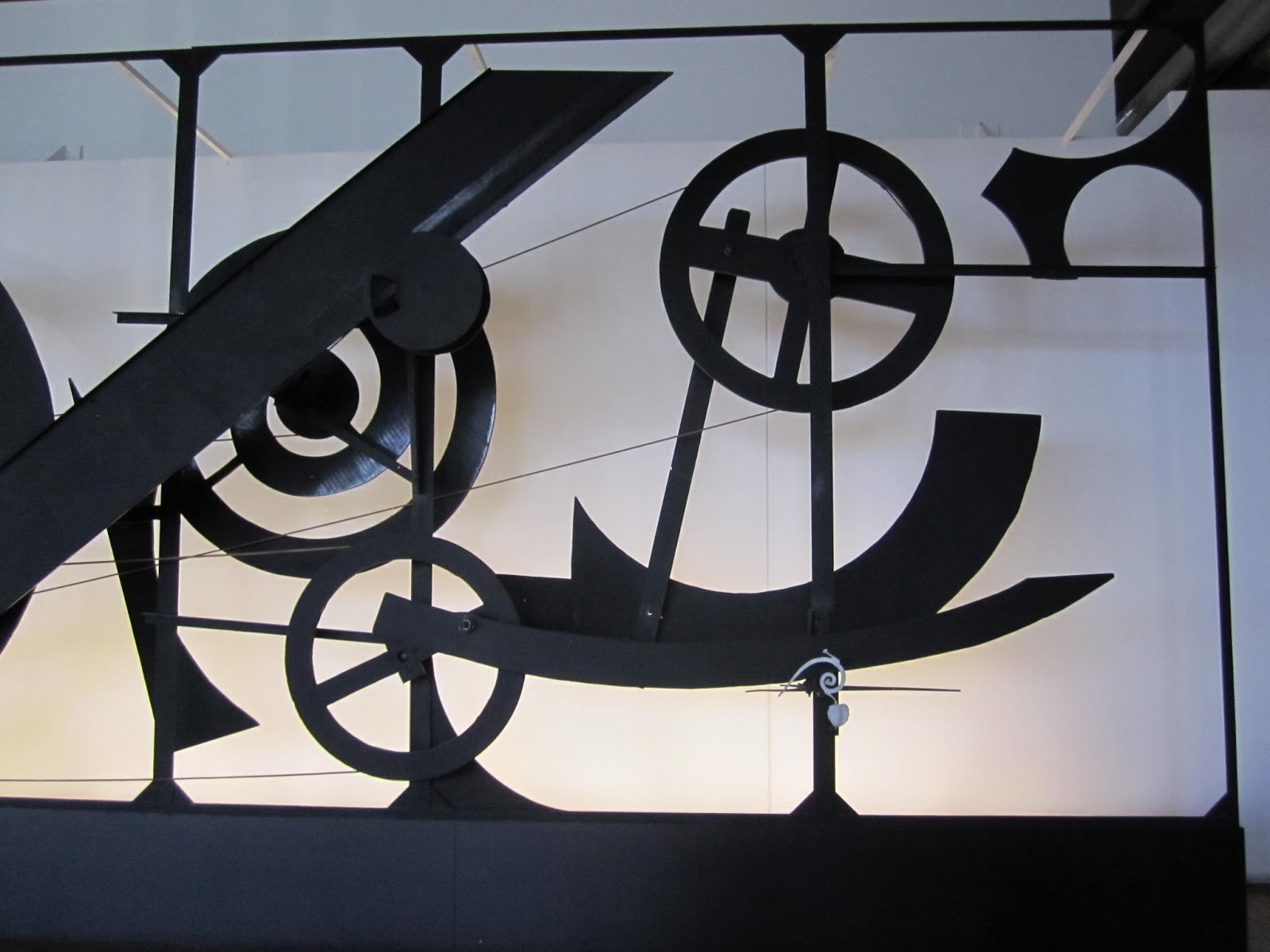
The photograph above was taken in Saint-Germaine-des-Pres; it's a room off the main part of the cathedral and looked like the perfect space for reflection.

Saturday, June 8, 2013

Final days in Paris


Yes, of course we occasionally behaved like tourists.  We took the Metro to the base of Montmartre, winding our way through the streets and up the stairs to that over-decorated wedding cake of a church, Sacra Coeur.  We took an odd way, though, through streets of fabric shops filled with the most appalling prints.  Then we took an unusually circuitous route upward so Veronica could take some photographs.  My favourite is of an open window with a beautiful staircase just beyond it.  We walked  straight through  tourist land, with its souvenirs, though had to fight our way through tourists photographing themselves in tourist land:  no simple little streets for them.  What is it we're all looking for? I wondered.  They want to record the experience of being a tourist, perhaps of following millions of tourists before them.  While we want a different kind of experience, in spite of the fact that we're...tourists.  This led me to think about the reality of our experience here.

For instance, I've drawn some conclusions about French children and how they play, though these have been based on the riotous, joyous sounds of children behind the walls of their schoolyards (yes, there always seem to be walls) or children in gardens.  Yet whose parents take children to gardens?  I have also come to the conclusion that the French are perhaps less obsessed about work than we are.  They have a 35-hour work week, yet they imagine to be among the most productive societies.  They seem to go out onto the street for smoke breaks, but certainly aren't hurrying to get back into the office.  They seem to take lunch with friends.  When we visited the Musee Marmotten-Monet, which is slightly off the beaten track, we stopped for lunch at a restaurant where we heard nothing but lively conversations all in French.  Yet unless I do a study of the people who work in the highrises we saw when we made our one Metro mistake and got on the wrong train in a line that divided in two, I have no idea what the French worker really thinks or does. We ate crepes on the street, something we have seen French people doing; while I enjoyed the dark chocolate folded into a freshly-made crepe, I felt like I was having a slightly fraudulent experience.

I made even wilder generalizations when we took the Metro from Montmartre to La Bon Marche, Paris's oldest department store, where I bought a thimble.  No, that's not a typo.  We went directly to the store's much-praised selection of buttons, fabrics, and wool, but could find little, except in the way of buttons, that we couldn't find in Regina.  They did, however, have whole wooden cases of thimbles that you could actually try on, and I found one that fit.  I have a single comfortable thimble, and lord help me if Sheba ever turns it into a toy.  Their beautiful stationary department still has inserts for Filofaxes and beautiful, leather-covered address books in purple and ruby red; have they forgotten that we live in the twenty-first century and that cell phones and email programs contain all the names and addresses one needs?.  I saw some lovely blue Moleskine notebooks, but I try to buy those from Paper Umbrella on 13th because I love that shop and want to support it.  We went up to the floor of women's clothing where we found haute style and even haute-er price tags.  In the midst of the stylish beige and black and soft blue we saw a pair of pink sandals with heels about six inches high.  The heels were actually a pair of plastic poodles sitting up that had rhinestone collar on.  Out of curiosity, I turned the show over and looked at the price:  1,345 Euros.  No, that's not a typo either.  Having seen countless French women--every one of them with a scarf--I can't make any generalizations about French style, except to say that we looked like tourists because we'd brought shawls and not scarves.

Occasionally as we were walking down a street, a couple of gates were opened into a courtyard with further doors beyond.  This perhaps is my metaphor for my minimal understanding of Paris:  there is simply so much we do not see in the public spaces.  On our way to the airport, we learned that even Parisians get caught in traffic jams, that they have a box store land, and that Parisian kids (at least one presumes  it's kids) love doing graffiti.  Every possible surface is covered, and in the Metro, on walls where there is really no space, people have left their signatures and drawings.  One suspects this work is done on a dare, between trains.

But Parisians write on their city in other creative ways.  During our last couple of days, when we were looking for presents to bring back, we made our way to a small shop called "Lil Weasel" in one of the arcades we hadn't traveled to on our first day there.  Three stories high, covered in glass, it is a lovely space with black wrought iron gates that are probably closed when none of the shops are open.  Lil Weasel, we suspect, yarn-bombed the gates with imaginative arrangements of bright knitted sea anemones, seaweed, and crocheted flowers.

Their buildings tell us something about their historical sense.  Central Paris--the tourists' Paris--has probably changed very little over the last century, though occasionally we found a row of shops with apartments above that had a simpler, more modern architecture.  At the same time, Paris seems always under repair.  On a walk of about half an hour, you will doubtless come across someone doing repairs to windows or painting trim or fixing a doorway:  there are ladders and tradesmen everywhere weaving in the loose ends of very old architecture.  Nowhere is this clearer than in their cathedrals.  We went into several of the smaller churches when we saw their doors were open, and Veronica would look all around and point out the early Norman arches of the nave, which was clearly built first.  Then Gothic arches take over, and perhaps stained glass that is even more modern.  The need to keep up an old built environment or the architectural layers of the churches suggest that Parisians, and perhaps even Europeans, are aware of the historical layers that stand behind the present moment. 

Our visit to the Musee Marmottan-Monet is of a piece with this sense of the historical layers that make up almost any space in Paris.  The building on the edge of the Bois de Boulogne was originally the hunting lodge of the Duke of Valmy.  In 1882, it was bought by Jules Marmottan, who left it to his son Paul in 1882.  Paul was a collector of the art of the Napoleonic era.  In turn, he left the house and its collection to the Academie des Beaux Arts in 1934.  While Paul's collection remains in the house, two major donations shifted its focus.  One was the  gift of Victorine Donop de Monchy of her father's collection of Impressionist paintings.  Doctor Georges de  Bellio had been the physician of Manet, Monet, Pissaro, Sisley, and Renoir, and had collected their work. In 1966, Monet's second son Michel donated his collection of his father's work, making the Musee Marmottan-Monet the largest collection of Monets in the world.  The house also holds the Waldenstein collection of Mediaeval illuminated manuscripts.  The Musee also hosts special exhibitions, in our case the work of modernist painters Marie Laurencin, a contemporary of Bracque, Picasso, Henri Rousseau, Delauney, and Derain, and the partner and muse of Guillaume Apollinaire.  While she was part of the cubist and Fauves circles, her work has of course been ignored in the broad swathes of art history that infamously and dishonestly edit the details of a period to a few "greats."

 So one's experience of the museum is slightly jerky:  you move from rooms full of portraits of  heroes of the Napoleonic period to gentle portraits of Berthe Morrisot and paintings of Monet.  Once you have finished the Laurencin exhibition, you again switch gears to look at the remarkable Mediaeval illuminated manuscripts.  The effect is a useful reality check, reminding you that any collection is, indeed, a collection:  that is a reflection of individuals' choices and tastes, and that the historical narratives used to hold those choices together with an historical narrative is ultimately a simplification. 

There is another element of the Monet collection that calls coherence into question.  I believe it was Cezanne who commented that Monet "was only an eye--but what an eye!"  It is Monet's serene and beautiful canvases, whether of the Houses of Parliament of snowy streets or hay stacks, of his gardens and water lilies, that one first thinks of.  Yet this collection contains quite a number of later Monets from the war and from his old age that are decidedly atypical.  During the war, the brushwork in his paintings of his water lily garden becomes agitated and he tends not to finish the edges and the corners of the paintings, foregrounding the his questions about art and representation.  By the time he began his last paintings, Monet was well into his eighties and he no longer saw the colours that you and I tend to see in, say, a lily pond.  Suddenly, dark winy reds make their appearance into otherwise natural scenes.  Doubtless Monet knew that lily pads weren't deep red and could have also red the names on his tubes of paint, thus keeping the colours of his paintings "accurate."  For whatever reason, however, he decided that he would give us a chance to see through an old man's eyes.  The effect is moving and unsettling, in about equal parts.

On our last day in Paris, I needed a book for the long trip back to Regina, so we went hunting for Shakespeare and Company, a left bank book shop that takes its name from the earlier institution opened by Sylvia Beach in 1919 that became a gathering place for expatriate writers like Hemingway, Pound, Fitzgerald, Stein, Man Ray, and Joyce.  The original closed during the German Occupation in 1940.  In 1951, George Whitman opened an English language bookstore in Paris that he called "Mistral," a name he changed  in tribute when Sylvia Beech died.  He termed it a "socialist utopia masquerating as a bookstore," and even had 15 beds where writers could sleep when they were in Paris.

I wanted serendipity to choose my book for me, so I picked up Hemingway's A Moveable Feast, about his life in Paris during the 20s, partly because I remembering loving it as an undergraduate and hadn't read it since then, partly because I was leaving Paris.  When I looked more carefully at its cover, I saw it was a photograph of the original shop with Sylvia Beach and Hemingway standing out in front of it.  When you buy your books at The Shakespeare Book Company, they offer to stamp it on the inside so you  have a record of where you bought it, a record that of, ourse resonates (whether you buy A Moveable Feast or not) back to before World War II.  My copy resonates doubly and perhaps even triply, since Hemingway talks about Beach's bookstore (which people often used more as a library), and because the stamp on the inside echoes the photograph on the outside.  In one of the later chapters, Hemingway, who hated Ford Maddox Ford with a passion that no one can quite explain, talks about sitting in his favourite cafe, the "Closerie de Lilas," "watching the light change on the trees and the buildings and the passage of the great slow horses of the outer boulevards."  Unfortunately, Ford came in and took over the scene with a conversation that Hemingway reports (how accurately is anyone's guess), leading Hemingway to report that "The light was changed again and I had missed the change." 

Fortunately, there was no Ford Maddox Ford in our evening, so after dinner Veronica and I walked to the end of the Isle de Cite, where you can watch the sun set over the Siene.  We saw for at least twenty minutes, sometimes watching people, sometimes watching the light.  We didn't lose a minute of it.
Tuesday, June 4, 2013

George Pompidou Centre for Art and Culture


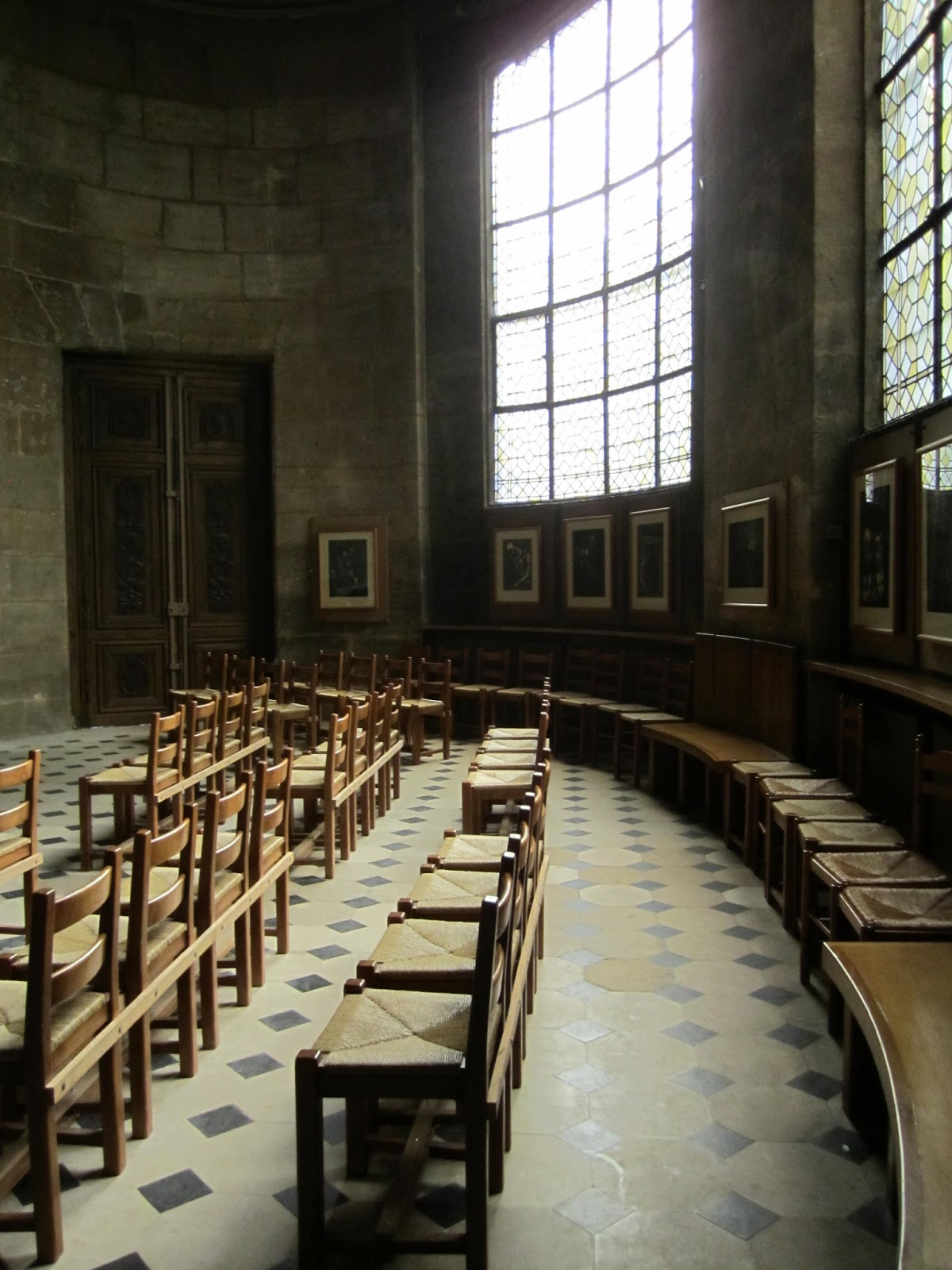
On the first Sunday of the month, Paris does something very civilized:  it opens its art galleries free of charge to the public.  We'd decided to do the George Pompidou that day, and it took virtually the entire day.  We were inside the museum by 11 and left only for a lovely lunch before calling it a day at 6.  They have two immense floors, and since the floor for art between the 1960s and the end of the century came first, that's where we began.  We had none of those feelings of being bull-shitted that had infused our time at the gallery of contemporary art of Paris.  Rather, we went from profound moment to profound moment while also feeling the inherent playfulness of the art the gallery's curators had chosen.  Your first view is of Tinguely's "Requiem for a Dead Leaf," a giant mechanical set of wheels and gears from which a small white leaf hangs.  (You can see the leaf about of a third of the way from the right hand side of the photo below, hanging from the first vertical bar.)  The piece is of an overwhelming scale, and many visitors stopped to take pictures of it, as if acknowledging how its monumentality struck them.  It was created in the sixties, and is perhaps an expression of the environmental movement begun by Rachel Carson in Silent Spring, where she argued that we could not continue to see industrial progress out of the context of the pollution it created, pollution which was damaging the environment.

Many of the pieces, interestingly, involved the experience of one's body--or the imagination of bodily experience.  The first of these was "The Winter Garden"  by Jean Dubuffet, which is a disorienting piece of art work that you actually enter and walk around inside.  It has Dubuffet's characteristic style--spaces of white outlined by unpredictable black lines--except that once you find yourself inside it, you discover how disorienting those shapes are; in addition, the floor was uneven, but the unevenness wasn't necessarily indicated by the black lines, so that space and line seemed to be on different planes.  Dubuffet manages to defamiliarize our experience of orienting ourselves and shows how fragile our sense of where we stand can be.  I tried to take a picture of it, but people kept going in and coming out, obscuring the space inside. 

The next remarkably physical work was Yaacov Agam's "Amenagement de l'antichambre," a room made of pleated walls; in turn, colour has been carefully applied to the backward or forward-leaning pleats while sometimes the opposite side was left white.  The result is that everywhere you stand gives you the sense of a different room.  To complicate our vision further, a chrome ball and triangle distort the walls around you.  This was another piece that people were quite willing to play with, walking back and forth, looking at the room through the coloured glass on either side, considering the chrome ball.  On the one hand, viewers are simply delighted by the play with colour; on the other hand, viewers may or may not be aware of the questions Agam is asking about how we see our world, how subtly it can be distorted, how many sides it can have.  Again, this speaks to the skill of the curators (not to mention the artists!).  Unlike those perhaps at the Museum of Contemporary Art in Paris, the Pompidou's don't try to put arguments on the walls, but to find ways of engaging with viewers.


 As well, there is no attempt on the part of the curators to pretend that art isn't, in some way or another, inherently political.  Another work that engaged people was called "Tutto" by Alighiero Boetti.  At first glance, it is rather  abstract and colourful.  But if you stand in front of it for any length of time at all, you find yourself recognizing countless objects.  It is entirely embroidered by Afghan workers after the Soviet Invasion of Afghanistan.  The artist worked on the shapes and arrangements, but left the choice of colours up to the artisans, with the proviso that there was the same amount of thread of each colour;  they could distribute it across the canvas as they liked.  There is actually seating in front of this piece (the galleries in Paris have, generally, way too little seating), and you could hear people calling out the shapes that they made out.

There was an entire room of "open work" inspired by artists like John Cage and Yoko Ono that made use of everyday objects in arrangements that gave them a significance they might not otherwise have.  My favourite of these was Robert Morris's "Card File."  You may have to be nearly as old as I am to remember these relics of office organization:  a long vertical file of see-through sleeves into which you could insert cards with categories on them.  Once you have established your filing principles, you can then file cards or slips of paper within the categories.  Morris's principles are quite intriguing; here is the selection from the "C" range:  cement, changes, communication, completion, conception.  Morris's work suggests that we might see ourselves, uncomfortably yet comfortingly, as having lives based on a series of principles or obsessions into which we might (sadly, perhaps) file our memories and our experiences.  One of the cards I photographed also suggests how we come back to concerns time and time again.

Two other artists also queried how we see ourselves.  One, so the didactic panel told us, had experienced something  like an identity crisis and had found about 100 identical biscuit tins into which he put everything that was in his studio.  Of course, the viewers of the artwork see only the rows of biscuit tins with cords running up them to the lights installed at the top, suggesting the extent to which this work is meant to live in a gallery.  So the artist as someone who accomplishes something was foregrounded.  In a second, there were boxes into which a photographer had put rolls of labelled but undeveloped film.  These works query who we are:  are we what we accomplish?  Are we our narratives or our memories?  Or are we experiences that are so rich and strange that no set of biscuit tins, let alone our own faulty memories, can contain everything?

The final work that really provoked us was "untitled" by Wade Guyton and Kelly Walker, though we came to call it "Yes, we have no bananas."  It is an installation of canvases that have been propped on the wall atop cans of paint whose labels suggest that when you roll it out you will have polka dots or checkerboards.  But there is one can, off to the left, that suggests it will allow you to paint bananas, though there are no bananas anywhere in the painting.  Again, this was a work with benches in front of it where people sat to puzzle out the fun, reminding me of Don McKay's reference to "homo ludens" while I was at Sage Hill.  We like to play.  It is one of our best ways of being thoughtful, critical, reflective.

At this point, we left the Pompidou for a lovely Italian lunch, returning to visit the galleries containing art made between 1905 and 1960. This is a more familiar narrative I can't relate with any fresh insights not already offered by art critics like Robert Hughes in Shock of the New.  The paintings on these floor was always  creative and adventurous, attempting to discover modernity as it unfolded, though the work created between the beginning of the First World War and the end of the Second was more often anxious, dark, pessimistic.  The work moved us both deeply, though we couldn't help being relieved, at the end of several miraculous hours, by the advent of the Sixties.

Monday, June 3, 2013

Markets, gardens, and a little art

We began Saturday planning to go to the Musee d'art contemporain de la ville de Paris--which is a ridiculously long name for an art gallery, but which Veronica and I had both enjoyed on our last trips about ten years ago.  The permanent collection contains some wonderful early twentieth century painting, including some lovely Bonnards and Vuillards and Chagalls--members of the Nabis and the Fauves.  But outside the museum there was a weekly street market that we thought we'd take in first. You could get almost everything there:  vegetables, fruit, plants, seafood, flowers, hats, shawls, lots of men's socks and hats, herbs.  Some stalls specialized in potatoes; others in mushrooms.  There was an enormous vat of paella.  Nikka tells me there were ells.
The market is a theatre all its own.  It brings out everyone:  the wealthy cook and the poor woman looking for a treat; the young who are looking for an unexpected adventure, and the old looking for the comfort and friendliness of their favourite stalls.  A nun in a white habit doing her shopping was treated with the greatest respect.

Once into the museum, we found ourselves disappointed.  There was some contemporary art that made me feel I was being bullshitted.  Four poorly knitted sweaters on a wall in awkward colour work of small squares of orange, gold, red, and blue represented the seasons?  A series of photographs taken from a window, all of which involved a wooden block placed on the window ledge, sometimes a square, sometimes a cylinder with a slanted top?  The photographs weren't even particularly interesting, though the exhibit also included the awkwardly carved and painted blocks.  The point of this is that we look for particular shapes in our urban landscape?  That what we see is shaped by how it is framed?  I'm not sure these ideas go beside Bonnard's lovely painting of the cherry pie.  Which we couldn't see because the permanent collection was closed for renovation as is the whole of the Picasso Gallery--another hoped-for destination.

So we had to make up the day as we went along.  My Paris book had told me about the Viaduc des Arts that had interesting shops underneath and a long Promenade Plantee on the train trestle that had once been above it, so we got out our Paris Metro map and found our way there.  The walk is wonderful:  the path is lined with roses, trees, shrubs, and plants of every kind.  In about two weeks, the whole place will smell of roses:  I have never seen rose bushes bloom so ecstatically.  The view of the streets as we passed them was also charming.  We caught the arrival of a wedding party, for example, or some nifty architecture.  While Napoleon III decided to create some wide, straight boulevard in order to be able to move troops more quickly and prevent the throwing of up barricades, Paris  is mostly an old city with meandering, crooked streets that the buildings must simply learn to live with.  There is almost a short cut somewhere, if you look for it.  But there are also several triangle tangles that you are going to hit in just the wrong way.  So enjoy the experience.
Parisians do street life in a way that we might see a little bit of in front of Atlantis Coffee or around the lake on lovely days.  We have speculated that many Parisians live in apartments above the shops that line the streets and that perhaps the lack of space there sends them down onto the street on lovely days.  It is also possible that they are simply so happy to have sunny, slightly warm days (today the high was 17 Celsius and many Parisians were in light coats), but interestingly, you don't make small talk about weather when you don't know the language.  We watched tourists with their maps, one of which asked us for help.  We watched grandfathers kick balls around toward grandsons as a way of burning off steam.  I remember that the last time I was here it saddened me to see streets without any trees, with not even any grassy boulevards; I wondered how Parisian children played.  Now I can say that they and the people who love them take them to the nearest park.  Toys, at least on the streets, seem minimal.  A ball and a scooter are probably enough.  Parisians children engage with the trees and plants and grass around them in interesting and intense ways.

On our way back, we looked into the shops.  You can get your eighteenth-century paintings restored there, or bring your violin to the luthier.  There are places where you can get very twisty turning green and orange lamp shades for your chrome lights, or find just the right sink for a new kitchen.  There are also shops with supplies for artists and crafters--quilting cotton, knitting wool, cross-stitch samplers in every size and style.

We ended our day at the Jardin des Plantes while it attempted to rain, though it did not quite succeed.  We found the Alpine Garden a particularly intriguing collection, including some very old trees, some extraordinary ferns, the usual explosions of irises.

Much of the Jardin Des Plants is fairly workmanlike:  rectangular beds filled with herbs or vegetables or medicinal plants, but perhaps generations of gardeners have lavished their attentions on the Alpine Garden, which the birds have also discovered.

The next day we spent seven hours at the Pompidou, being simply blown away by both contemporary arts (sans bull shit) and art at the turn of the century.  I'll tell you about that tomorrow.  

Friday, May 31, 2013

Working bodies, wallpaper, knitters and quilters

The sun has finally returned to Paris, and I am sitting on my balcony--oh, hardship!--to watch a woman on the street opposite do her laundry and to write to you.  To be fair, there was sunshine yesterday, as well as torrential rain, but we spent 7 hours in the Musee d'Orsay, so were bothered by neither after we waited half an hour to get in.  And while we waited, we were helplessly privy to a lover's quarrel going on in the line ahead of us.  He was arguing about the line, which was indeed very long but which was also moving very fast.  She was emphatic about wanting to go to the Musee, which was open until late last night.  He finally won the argument, but I didn't know which of them made me more furious:  him for being a bully who didn't appreciate art or her for giving in.  (Veronica suggested--is she cynical?--that he'd have sulked for the rest of the holiday if the woman had simply said "Fine.  You go your way, I'll go mine.")  The reward for their decision was that just at that moment we arrived under the enormous awnings of the Musee, the skies opened, drenching both of them.  As we walked through the two islands in the Siene this morning, we noticed that there are walking paths that are completely under water.  As well, some American tourists reported to other American tourists (do they all have beacons on them so they can find one another?) that their cruise had been aborted because the water was so high that the ship could not get under bridges.  So lest you think that my opening--"the sun has finally returned"--is a little self-indulgent--you need to know that it's been a very cool and rainy spring in Paris.

But yesterday, weather didn't matter unless it was on the canvas before us.  The Musee gives you a brief,  rough and ready picture of pre-Impressionist nineteenth-century painting  before you ascend to the Impressionists.  One of the main genres approved by the French salon was history painting:  enormous canvases with millions--okay, hundreds--of tiny figures that freeze some historical moment.  In The Content of the Form, Hayden White argues that when we narrativize history (and yes, "narrativize" is a word: it means to force something into a narrative shape) we force a set of events into a sequence that has the increasing conflict of the rising action, a crisis, and a denouement.  So what we regard as history as often battles, conflicts, heroic ventures.  French History Painting does this with a vengeance.  Looked at with a certain viewpoint, they are simply celebrations of masculine heroism mostly set in classical or neo-classical times.  Were a Martian to fall to earth and have access to only this period of painting, she would think humans were very peculiar and would perhaps wonder most of all about the way the female nude was depicted over and over again--often without her head.  Was this some kind of fetish?  Some idealization or commodification?  Puzzling.

What you find when you get beyond this work to that of the Nabis is that there are suddenly bodies at work.  Normal bodies.  Tired bodies.  Grateful bodies.  And when we're getting indoor scenes and there aren't labouring bodies, there is wallpaper recorded on the canvas with numbing detail (at least it would have numbed me if I were the painter, to get all those white flowers on the pink ground more or less symmetrical and lined up).  Bonnard, Vuillard, Denis began recording everyday life, often in brilliant and joyful colour.  I have thought long and hard about the kind of novelist I want to be.  I know that "bigger" novels dealing with war or politics or extreme and dramatic situations tend to get the most critical attention, but this is really not what I'm trying to do.  It's your life, a corner of the life you might have lived or a sliver of the life you see in someone you love that I want to illuminate and celebrate, if I can.  I don't know nearly enough about the Nabis--I didn't know the term even existed--but learning about them seems like one more excuse to retire.  It comes from Hebrew and means "prophet,"though their joyful and even decorative dailiness seems the antithesis of prophetic, unless the point is to see the colour, joy, and beauty in one's everyday life.

What can I say about the Impressionists and Post-Impressionists that hasn't been said before?  At some point, I felt as if I'd eaten too much chocolate or gorged on something similarly rich.  That was, fortunately, a moment when Veronica and I could sit down  on the museum's benches (which are too deep for little old ladies like me) and wax philosophical.  Perhaps their very choice to paint en plein air meant that they saw beauty where they found it in the world.  There was no arrangement of vases in the studio or of perfect nude models.  There was, perhaps a snowy day that could be focused by placing a single black bird on a fence.  Or an alley of trees or a hillside of poppies.  Since Elaine Scarry's  1990 lectures On Beauty and Being Just, philosophers have been thinking about beauty in quite different terms, as if it gestures toward some civil virtue or virtues.  Let me simply say that in these galleries, which were jam packed, people were unfailingly polite.  Mrs. Dalloway is sure that her love for beauty will help the Armenians (Or was it Albanians?  She has difficulty keeping the objects of her political husband's political enquiries straight).  What you are left with, after you have seen room after room of Impressionist paintings is a way of seeing the world, plus the memories of canvases you are sure you could have returned to again and again to take away something different each time.  True beauty is complex, and wants to speak again and again.  Interestingly, if you listened in the museum, what you heard was a delicious hum of people talking to one another about what we saw.

After nearly eight hours on our feet yesterday, we decided to have a simpler day today, walking through the small shops on the island to the east of the one that holds Notre Dame.  There we found small shops of silk scarves and really goofy, delightful kitchen equipment (does anyone need me to bring back a plaid toaster?).  Here and in the small shops along our route to La Drougerie, one of Paris's premier knitting shops, we found colour and fun.  There was a table that had been covered, I suspect, with some kind of resin into which had been pressed every wild kind of bead or button you could imagine--right down to its toes.  There were white vases that looked like they'd been covered with very chic fridge magnets.  There were silk scarves (from which French women acquire some of their style) of every colour imaginable.  It was a cold, rainy, windy day, but Parisians were still having fun.  They continued to have fun at La Drouguerie, where you could find exactly what you needed to re-decorate your straw hate or just the right purple linen to make yourself a summer sweater.  Creativity lived here.

I ended my day today with a story.  Quite close to use (and no, this didn't influence our choice of a hotel) is a French patchwork shop called "Le Rouvray."  When I went in at the end of my day today, the shop keeper didn't sing out "Bon jour Madame!" the way they invariably do, but continued her hurried phone conversation, which gave me a chance to choose some lovely blue and brown fabrics.  When we finally began to talk, I asked her whether the quilt behind her on the wall was a copy of "Dear Jane."  The quilters will know what I'm speaking of.  There are hundreds of small four-inch blocks, many of them very complex, and none of them the same.  She said that she had started it with her mother-in-law when her own mother was quite ill.  Doing all that hand piecing helped her get through a difficult time.  She has now moved on to a similarly complex project that's called "Nearly Insane," which is of similar crazy complexity.  She does all her piecing by hand and doesn't even know how to use a sewing machine.  While she cut my fabric we talked simply, in English, about the ways that our projects distract us in difficult times and give us the sense of control in our lives--something you need even in Paris.


Wednesday, May 29, 2013

Arcades, Cathedrals, and Gardens


We arrived in Paris in the rain.  As well, the planners of the major train station between Charles de Gaule and central Paris assume that you can carry your suitcase both up and down several flights of stairs.  So thanks to a young man who helped me up the final half flight up out of the train station, we arrived at our small hotel wet and tired, dropped off our bags, and hit the street again to find ourselves some lunch.  The little restaurant we found is clearly a neighbourhood haunt (we are in the heart of the Left Bank); the host prepared one table in the corner for a customer who had not yet arrived by placing a glass of red wine and a basket of bread there.  The gentleman sauntered in about five minutes later.  I had the slightly surreal  feeling as I sat there, a little giddy from lack of sleep, that I was appearing in a movie whose plot I had no sense of.  There was activity all around me, people being voluble and emphatic, making dramatic gestures you only notice when you don't understand the language very well.


Our guide book suggested that a good thing to do in Paris on a rainy day was to visit the arcades, and since I've been reading Benjamin's Arcades Project for the poems inspired by Veronica's very urban photographs, this seemed like a good idea.  As luck would have it, it poured until we reached the arcades, which took longer than it should have because we'd put the less detailed map in our pockets. And of course, once we arrived, the rain mostly stopped.  The arcades closest to the Louvre are fairly empty; it's only when you get to the older ones that they come, perhaps, to embody excess--something I'm not sure Benjamin writes about.  Pastries.  Shoes and handbags.  Jewellery--bijoux, really.  Old books.  And then we found the simple little shop  that I photographed here.  This is their "basement," with stone walls into which they have created many fun little spaces to put their simple things. 

Today we started with the promise of sunshine and cappuccino or tea and croissants at the bakery right across the street.  I had forgotten what real croissants taste like.  Then we walked to the outdoor sculpture garden on the Sienne (closed--echoing my experience of Paris in 2001, when everything was closed for a strike), and then on down some tiny little streets.  We found, entirely by accident, a quilt shop which was not open, a shop for needlecrafts.  (There's a second photograph of this shop below, and I've managed Veronica's "reflection" effect, getting the context for the shop into the window reflection.  I see why she likes doing this.)  Bookstores again--lots of specialty bookstores for the very bohemian Left Bank. 

Some of the questions I had about Paris last time have finally cohered into a single, larger question:  how many Parises are there?  It's impossible, given the number of people with maps in their hands, not to see that there is certainly a Paris for tourists.  There is also a bourgeois Paris, judging from the shoes, jewellery, handbags, and beautifully tailored clothes you see in store windows.  There is also a small business person's Paris, a person who keeps a shop of exquisite Japanese pottery, or antique books, who doesn't feel he or she needs to keep particularly regular hours.   On the Left Bank, there is a students' Paris, evident in the bookstores and inexpensive paninis.  But there are two other versions of Paris I can't quite ignore.  One is the workers' Paris--people who ride the metro long distances to get to their jobs serving food and cleaning hotels in central Paris.  On the subways, they look bored and tired.  Then there is the homeless Paris, people who in yesterday's rain knew exactly the little alcoves where they could make themselves comfortable.  Many of them have dogs--an extra expense, doubtless, but the need for loyal companionship I completely understand.

After a lovely lunch of roast chicken with herbs and tarte aux pomme, we went on to the church of St. Severin, which was built in the 13th century, enlarged between then and the 16th century, amended in the 17th, and finally given new stained glass windows in the late twentieth century.  (That's a segue from homelessness to simple wonderful food that the nested Lenin baba doll I saw would query.  At the same time, can you imagine a whole shop of nothing but nested Russian dolls?)  Somehow I expected that the heritage police would have intervened at some point, but they haven't.  History in Paris is a process, not a time.  Surprisingly, the modern stained glass windows go wonderfully with the mediaevel spiralling pillars you see below.  


South on more small streets (we try to stay off the noisier main streets), we made our way to the Luxembourg Gardens where  we ran smack into a pocket of Parisian minimalism (if that phrase isn't a kind of oxymoron).  People can find quite minimal pleasure in the gardens of Paris.  Usually it begins with a friend or with grandchildren.  If you are a foot-weary tourist, you find three chairs for the two of you--for a place to put your feet up.  It might involve crumbs for the pigeons or one of the sailboats children can use in the round pond.  I don't see children here loaded down with toys; I do see lots of children on little scooters that parents pull as they walk along, or that big sisters push with one foot while their little brothers stand stolidly gripping the handle bar.  One element of minimalism may be time:  the time to enjoy, read, glory in one another's company, be playful.  You don't need much, besides good company, to do these things.

On from their through more small streets to St-Germain-des-Pres, which is one of Paris's oldest surviving buildings, a "rare Romanesque structure structure that dates back to the late tenth and early eleventh centuries" (Rough Guide to Paris 136).  Once again, there is that profound sense of layers which are under the nineteenth-century painting.  We wandered the small streets around St.-Germain-des-Pres until our feet could stand no more--Veronica even declined to go down a promising little narrow street because the cobblestones were impossible to walk on with blistered feet--and then found tea and chocolate tart for her and cappuccino for me.  Ever true to my practice, I found the shortest way back to the hotel, and am now writing this on our balcony.


Saying that paints too swish a picture of our tiny room where Veronica and I do a funny little dance when we need to get by one another.  All the same, the view is spectacular, and I am sitting on a balcony in Paris thinking about paying attention, or as Don McKay suggested for one of the poems I worked on at Sage Hill, "giving attention."  On holidays, particularly to places like Paris, we look forward to seeing something new, perhaps something that challenges our everyday ways of being in the world--assumptions hidden in our relationships with others or in our relationship with our context.  That has certainly happened here:  Parisians interact differently with their social and public space than Canadians typically do.  I think they are more dramatically at home in them.  But what often happens on holidays is not simply that we see something new, but that we concentrate on seeing.  We're thrown into time in which we have nothing to do but feast our senses, primarily our eyes.  How much we give ourselves when we give attention to our world.

The photograph above from our balcony, as you might guess from the quality of light, was taken by Veronica.  The rest are my handy point-and-click. 

Sunday, May 19, 2013

Birdwatching with Don McKay

The pace here at the Sage Hill Poetry Colloquium has been measured yet intense.  Because I'm working with Veronica's photographs, I don't have to wait for the muse; her work is my muse. I simply choose a photograph and read around it or stare at it long enough to find a way in. (Today I was reading Benjamin's Arcades Project.)  Many of them are almost metaphors for the human experience or condition or the human world we create:  they give me a rich range of things to write about.  Then sometimes less than a day later, we workshop it.  My colleagues here are exacting and helpful.  Then it's on to another poem.

So on Sunday, many of us needed a break.  Don McKay had checked out a park at the bottom of Last Mountain Lake, one where I've often been, and I suggested a drive along 99, a mostly dirt road that runs at the foot of the valley between Craven and Southey.  Nine of us scrunched into two cars, I leading, Don behind.  I can tell you a secret about Don McKay that is no longer a secret.  He's a fairly leisurely driver on roads marked 100 km, (in fact, you can lose him) but he goes like stink on dirt roads.  I got a little worried when I could no longer see the dust he kicked up.  But I also learned that if we're in bird-rich landscape, it makes more sense to let him be the lead car.  Rather than stopping because you can see that he is way behind you and has gotten out of the car with his binoculars, and wondering what he's seeing, you can stop just behind him and see the same things.

At Last Mountain Lake, I saw and heard many things that I've seen and heard before, except now I know what they mean.  There's a difference between merely passively seeing and actually noticing, a difference between  taking note, rather than simply letting the sounds and sights wash over you in a pleasurable but ignorant melange. We watched a Killdeer set up her nest in some mud, some shovellers on the shores, red wing blackbirds, terns, lots of geese and ducks.  Along 99, we saw a pair of Swainson's Hawks sitting on a fence, I heard a Western Meadowlark; two flocks of 6 pelicans serenely sailed the thermals down the  Qu'Appelle Valley.  I learned to tell a Barn Swallow from a Tree Swallow (which isn't rocket science).  It was a beautiful day; in fact, beauty swept you off your feet at every turn.  I was brought back to the magic of the Qu'Appelle Valley by the reaction of one of my classmates, who had never seen it before, and so who allowed me to see it anew and feel wonder anew.

In some ways, this wasn't a day off:  it was another poetry lesson.  I have a feeling that identifying birds isn't a matter of seeing them clearly posed on a nearby tree and recognizing them from their pictures in books.  Because you seldom see them that clearly.  You need to understand their behaviour, their habits, their songs, the patterns of their flight, their habitat.  Experience gives you fragments of some of these things--you can see a wing, a throat, or some tail feathers; you hear a bit of song--and you need to make something out of that, just as life's experience gives you fragments that you eke out with your own imagination to make a coherent whole that, when truly crafted, is as alive and perhaps as fragile as a bird.   Much like birds, you have to understand poems and all their unruly and unpredictable habits, or create them on the wing as they flit just outside of your consciousness, just at the edge of language, that place where you need the second language of form to help you unearth that uncanny, unearthly thing, the poem.

Sean Virgo was here earlier in the week, and he talked about the fact that it is the poet's job to create beauty.  I reached into my pocket of definitions and pulled out Alexander Nehamas's understanding of beauty--which has nothing to do with any kind of prettiness.  Nehemas normally writes the kind of philosophy where every point is pinned down before another one rises up out of the implications of the first.  But when he comes to define beauty, he suddenly gets very personal, talking about the people we love and their particular beauties.  For him, when we return to something or someone or some place time and time again because we know that each time it will repay our curiosity,  because it will tell us something more about itself or ourselves or our world, we have come face to face with beauty and perhaps with love.

I have been thinking a lot about voice here, with Don's voice at the fore.  How does such wisdom and knowledge of earth and human become these unerring, seemingly simple and humble lyrics that we listen to or read with such attention because we know there are depths and depths beneath the surface?  Watching his awe over a pair of hawks made me suspect that fleeting beauty and his love of it, his dedicated fascination with bird and rock and human  have become so much a part of him that they are transfigured into deep, humble knowledge.

Tuesday, May 14, 2013

Sage Hill's Generosity


Jane Austen has a lovely little metafictional moment in her first novel, Northanger Abbey, when she observes that many women writers don't read or praise the work of other women writers.  And if a novelist can't depend on another novelist, who can she count on?  I think the same is true of poets.  When you consider that more Canadians think that Elvis is still alive than read a poem in the last year, you realize that we are perhaps one another's most avid readers.  That might account for our behaviour when we get together.  No movie scripts, cat fights, or gossip columns here.  What I have found is the most remarkable and imaginative yet rigorous support.

The monastery helps.  There have been all manner of celebrations within these walls, and we hang around the dinner table with glasses of wine (sometimes to the dismay of our Franciscan hosts who would like to wash our dishes so they can finish their own days), telling our favourite (and often groan-inducing) jokes.  But there is also remarkable discipline suggested by our monastic rooms.  This sense of purpose is heightened by our sense of good fortune to be here working with Don McKay, one of Canada's finest and most generous poets.  The Qu'Appelle Valley helps. Sometimes there are as many as seven of us sitting in the comfy chairs reading or writing in a magical, pregnant silence, uninterrupted.  There has apparently been wildlife, though I've missed it all.  People told of a coyote chorus last night around 1 a.m., though all I heard were banging pipes.  There have been deer and owls and the obligatory and numerous ticks.

On our first full day together, we all talked about our projects, talked about their challenges and read a single poem out loud.  I learned, first of all, that I have to get my classmates' reading lists.  My own sense of what is happening in Canadian poetry right now is rather narrow, and I learned much simply from the joyous cacophony of styles and subjects my classmates are exploring.  Now I can analyze a poem with the best of them, but they have a way of bringing up issues of craft that I'd never considered.  (We're not just talking line breaks here.)

The first task Don set us was to take an object important to another classmate and write a poem that defamiliarized it, that looked at it as we might if we were from Mars.  He urged us to make conjectures about its secret life, to see its independent existence unconstrained by our sense of its use, referencing some Polish phenomonologists who no longer trusted ideas but only things.  I am ashamed to say that, caught in the drafting of a poem for my book and completely puzzled by what it was I held in my hand (it looked like a concrete bird that had been broken off something but was apparently the fossil of something--a claw, I hypothesized) I tanked on this assignment and would like to try it with something that perhaps wasn't arbitrarily chosen for me.  Perhaps we can only defamiliarize the familiar.

Don also talked about the creative imperative.  Some times we feel that there's a fence or earth wall or barricade in front of us.  He suggests we simply cross it to find out why it's there.  Sometimes those barriers are tabu, which makes them not only things perhaps to avoid, but things with energy.  He asked about our allegiance to intelligibility; I can tell you that mine is high, at least when it comes to syntax.  If someone can't sort out a sentence (I care less whether they can make it mean something), then I need to do some clean-up or rearranging.  He talked about the energy enjambment creates, the way we leap across the lines, the kind of syncopation or swing it creates that end-stopped lines or lines that are simply phrases don't have.

Our second group meeting was a workshop where my classmates argued and suggested and cajoled about issues of craft, ideas about what belonged in a particular poem, about ways to read and ways to write.  Even before they came to my work (I was the last one for the day), I learned so much from them that it made my head spin.  Next morning I woke exhilarated, ready to revise, torn between doing that and finishing a poem I'd begun a day before.  I feel as if I'm getting the hang of this syncopation that moves words in an entirely different way.

Don ended out first workshop with a remarkable mini-lecture that I certainly won't do justice to here.  He said the eros of poetry came from the love between the lyric moment--which wants to stop time, to go on being a moment as long as it possibly can, and the narrative drive, which asks "And then?" and "What next?"  He talked in a way I found helpful about the lyric novel which subverts that narrative drive with lyrical moments that don't want to go anywhere, and even explained what I might have been trying to do in Blue Duets.  He says you can create a lot of energy when you break the rules, but if I know myself as a writer and as a social being, I know that I often don't know where the rules are, what the rules are.  Sometimes that's a blessing rather than a curse, though if I knew the rules, I could ignore them, couldn't I?

Tuesday, May 7, 2013

Shadows

 Spring, as we have all been whining, has been extraordinarily reluctant this year.  This has left many of us in Saskatchewan disoriented, as we look out the window at 8 p.m.--and we know it's 8 because we feel that dinner has settled and that we're end-of-day tired--to see it still light outside and the blue hour coming down on snow.  I've been aware that the trees are reluctant to bud, the grass cautious about extending some green into the grey-brown lawns (are they also greyer and browner than normal?), because normally I am watching these changes as my poor students write their final exams.

So I've found myself watching the shadows on my walls.  I suppose in some way this is like saying that I'm watching the light.  But the shadow of branches with a bird at my feeder or the shadows of tangled branches on my kitchen walls have been, perhaps, a reaction to this spring's spare beauty--a beauty almost reluctant to arrive, but unable to stop itself.  There have been lots of butterflies in my back yard, but I lose them as the fly into the sun and can more easily watch their shadows.

There have been other shadows.  Saturday was Angela Oxman's funeral, and since her death two weeks ago, I have been aware of how she is a shadow:  how I think about her delight in spring and in her garden, how I realize that she should be out in that  lovely slanting end-of-day light to see what has ventured up, to admire the green shoots, maybe even admire the tenacity of this plant, that shrub, these bulbs, their determination to reach for sunshine when the earth itself it still cold.  Or I will think about her nurse's take-charge belief in life, and realize that this lives on only in our memories of her.  It is up to us to continue to carry her in the world, something I suspect her dear husband, who kept her home to the end, and her sons will do with aplomb and devotion.  


Maybe this is something about death that you only learn intuitively when you lose someone very close to you, someone whom you know so intimately that in a crowd you see their gestures out of the corner of your eye, hear their favourite expressions, see their world view right alongside yours as you consider a problem.  It's been difficult for me to explain, but my parents are more present than they were when my father was an unspeaking old man who could only take my hand or lean his head into my shoulder, or than when my mother was made completely unfamiliar (well, not completely) by her fury at losing reason, her ability to think, her grip on reality--a fury she hurled at everyone around her since she couldn't aim it at that abstract thing--time--that was stealing it. Now they come back as small joyous fireworks in phrases or memories that, over time, come as close to a mental hologram of them as it's possible to get.  For all that they are shadowy, it's the light they give off that surprises.  

Sunday night, Bill and I took our first long walk of this spring, both of us with our cameras, because they somehow help us pay attention to what's around us.  The trees have finally begun to bud, two weeks late by my estimate.  The blackbirds are back by the creek, the mourning doves' wings are whistling in my back yard, their sad coos lifted out of sadness by the light and warmth.  The robins' songs twine into my work room, where I don't mind being a little cool if it comes with birdsong.  Much of what is around us is dominated by the shadows of last fall and winter,  but the light is unmistakable.

Tuesday, April 30, 2013

Stories and the realities they create

Particularly in times of fear and confusion, we want stories; pointless violence like the bombs at the Boston Marathon makes us want stories that will explain why--even while many of us feel that any explanation the bombers could give would not be, literally or figuratively, a reason.  (I'll admit that I had problems with language in that last sentence:  which was a reason, which an explanation?  Let's just say that the explanation that made sense to the bombers would not seem reasonable to us.)  One of Obama's gifts as president, when he isn't being hamstrung by a Congress that has neither reasons nor explanations for their failure to pass gun control legislation, is to be storyteller-in-chief.  It's his job to create the narratives that go some small distance toward restoring order and confidence:  to tell the bombers that they will be caught, to tell the victims that they will run again, to assert the triumph of goodness and hope and will.

But even while we're hungry for this narrative we're also often disgusted with what that media offers us for stories.  Novel Prize-winner Daniel Kahnemann notes that the prevalence of stories about bird flu or child abductions--stories that make us frightened--set up what he calls "availability cascades."  That is, by over-emphasizing some threats, the media nudge us to take actions that are not really in our best interests.  Michael Cohen, writing in The Guardian, pointed to a crucial disconnection between locking down Boston for a day and Congress's failure to pass laws restricting the sale of guns without more thorough background checks:

"The same day of the marathon bombing in Boston, 11 Americans were murdered by guns. The pregnant Breshauna Jackson was killed in Dallas, allegedly by her boyfriend. In Richmond, California, James Tucker III was shot and killed while riding his bicycle – assailants unknown. Nigel Hardy, a 13-year-old boy in Palmdale, California, who was being bullied in school, took his own life. He used the gun that his father kept at home. And in Brooklyn, New York, an off-duty police officer used her department-issued Glock 9mm handgun to kill herself, her boyfriend and her one-year old child.

"At the same time that investigators were in the midst of a high-profile manhunt for the marathon bombers that ended on Friday evening, 38 more Americans – with little fanfare – died from gun violence. One was a 22-year old resident of Boston. They are a tiny percentage of the 3,531 Americans killed by guns in the past four months – a total that surpasses the number of Americans who died on 9/11 and is one fewer than the number of US soldiers who lost their lives in combat operations in Iraq. Yet, none of this daily violence was considered urgent enough to motivate Congress to impose a mild, commonsense restriction on gun purchasers."  (You can find a link to Cohen's essay below.)


 Here's my own recent favourite from last week.  CBC has been reporting 11 cases of a new bird flu in China, even though human-to-human transmission hasn't yet occurred.  At the same time, the media doesn't tell us that, world wide, approximately 2,740 people die in automobile accidents every day--for a total of over a million a year.  Our media and our leaders have clearly figured out that prompting us to be fearful helps their ratings or their election chances, but they're not quite willing to share the stories that might undermine our entire way of life, whether those stories are about guns or cars. Yet the stories they tell profoundly shape the way we feel about our lives and our world, perhaps because a sense of physical security is a cornerstone of our sense of well-being.

Stories make powerful explanations.  We can watch the fascinating narrative arc while at the same time waiting for the denoument that ties causes to effects.  They explain our world.  Yet at the same time, our confidence in stories as agents of explanation is perhaps misplaced. You've done it:  a friend or a family member does something that you find upsetting, puzzling, or hurtful.  So you make a story about it, linking it to other events or comments, only to find it's the wrong story.  It wasn't an insult; it was embarrassment.  They weren't avoiding you; they were trying to give you space. 

For my exam period entertainment, I've been reading a book of essays by Tony Judt called The Memory Chalet.  The essays arose from his middle-of-the-night conversations with his memory while he was in the later stages of ALS.  Unable to write or type, he would use a chalet that was part of fond childhood memories to help him construct fairly brief essays--he calls them feuilletons--that he would laboriously speak to his emanuenses in the morning.  In one of these, he admits that he thought he knew America:

"For West Europeans raised in the 1950s, "America" was Bing Crosby, Hopalong Cassidy, and overvalued dollars flowing copiously from the plain pants pockets of midwestern tourists.  By the 1970s the image had shifted away from the cowboy West to the Manhattan Canyons of Lieutenant Kojak.  My generation enthusiastically replaced Bing with Elvis, and Elvis with Motown and the Beach Boys; but we had not the slightest idea what Memphis or Detroit--or southern California for that matter--actually looked like" (158).

Similarly, Judt certainly had an illustrious career as an historian both in England and in the United States, but it wasn't until he had a midlife crisis that prompted him to learn Czech that he realized how partial his understanding of European history--one that ignored Eastern Europe--had been.  (I think I'll learn a language for my next midlife crisis.  It sounds at least more useful than a car or an affair.)

Judt's experience is not exactly a surprise.  Anyone who deals with ideas knows that any coherent narrative that maintains enough interest to grab a reader's attention is going to be problematic.  Historian Hayden White calls this the Content of the Form, a book of groundbreaking essays on history and historiography.  White argues that our expectation of a narrative arc determines what events we think are appropriate for history.  Good historical stories have heroes and villains, battles and triumphs or defeats.  The slow attempt, recorded by the French Annales school, to figure out how thickly to plant wheat and how heavily to lay on the cow manure in order to maximize one's crop doesn't make for captivating reading. But that struggle probably influences our contemporary lives more than, say, the Battle of Agincourt.

Yet I've discovered of late that even stories about institutions inadvertently create an inaccurate portrait.  This has happened of late at U of R.  The stories about IPAC finances have put the university's attempts to develop carbon capture and storage capacity on the front pages of the Leader Post and on the CBC news.  Ditto the story about how Engineering solved a $1.3 million shortfall.  At the same time, however, there were some quieter stories happening elsewhere that suggested that members of the university were quietly working to sustain the environment and develop links with the community.  For example, the university has community gardening projects, called "The Edible Campus,"  that make a profound difference in the community.  Last year, the gardens behind the library, outside the Language Institute, and at FNUC donated 1,500 pounds of fresh food to Carmichael Outreach.  At the same time, "Fruit for Thought," a student-led effort that evolved out of Katherine Arbuthnott's Psychology of the Environment class, harvested 30 trees and gathered 3,000 pounds of fruit, some of which went to the Regina Food Bank.  These two organizations have been rewarded for their efforts:  the Community Gardens received a Farm Credit Corporation Regina Spirit Fund Award, and Fruit for Thought was given a SaskPower Waste Minimization Award.  The Edible Campus (which includes these two projects) was given a Regional Centre of Expertise on Education for Sustainable Development in Saskatchewan Award for "contributing to creating and sustaining awareness of sustainable food practices in Saskatchewan."

On another front, RPIRG and members of the Faculty of Arts have been instrumental in the creation of the Public Pastures-Public Interest group which spearheaded the very productive Pastures Forum that I wrote about on November 30.  This effort has caught the attention of Margaret Atwood, who, along with her husband, Graeme Gibson, will be visiting the community pastures between June 24 and June 27 "to draw attention to the global significance of conservation programming and bird habitat at risk on federal community pastures now being transferred to Saskatchewan."  She will be tweeting about the experience to her 392,000 followers, attempting to raise awareness about these lands that are at risk.  And, apropros of the U of R's investment in Carbon Capture and Storage Technology, these pastures capture 2.5 times the carbon of any storage technology under development.  And they're already there, already playing an important role in protecting species, in rural ecosystems and in rural economy by providing work for pasture managers and managed grazing for ranchers.  

So what do we do about the fact that we are inclined to tell and trumpet the stories of IPAC and the Faculty of Engineering, when there are other, quieter stories of success and dedication?  Is it that we can't help following the big money?  Does money control more than we think?  Does it decide which stories are important?

Last Saturday night, the Saskatchewan Book Awards had its gala celebrating its twenty years and recognizing writers and publishers across the province.  Each of the writers who won awards had stories to tell about the people and the communities that supported them, about the curiosity that drove them, about the rewards (rarely financial) of the work they do.  For each of those stories, there were four or five others that any of the nominees might have told.  In turn, what we celebrated on Saturday night is the enormous and exciting variety of stories that sustain a culture. 


 You can find Cohen's essay in The Guardian here: http://m.guardian.co.uk/commentisfree/2013/apr/21/boston-marathon-bombs-us-gun-law

Here's the link to the Public Pastures website: http://pfrapastureposts.wordpress.com/about/who-we-are/ 

 Here's a link to my earlier post, "Time and the Land" about the Pastures Forum: http://blueduets.blogspot.ca/2012/11/time-and-land.html

 Here is a link to the SBA web page, which will help you follow the upcoming readings: http://www.bookawards.sk.ca/index.php
There will be a reading over lunch at the Legislate Library on May 8.  Just in case it's an incentive, the library provides lunch.  Candace Savage will be one of the speakers.  I'll post updates on FB to keep you informed.