Which of our senses most powerfully gives rise to memory? Proust would argue, of course, that it is taste, given that a book of 4,300 pages came from the taste of a madeleine dipped in tea. Some scientists think that our sense of smell--our most complex and primitive sense, one we still can't fully explain, takes its stimuli right to the stem of the brain. Cinnamon. Pine trees. Baking bread. Our young children. Apparently women can recognize their biological children--but not their stepchildren--from their smell. If you're a mom, you'll remember that powerful whiff of recognition.
But I'd like to argue, for today anyway, that it's touch. And I'm making the argument backwards, as it were. Who doesn't have powerful memories associated with the crisper, drier air of fall? Or of first snowy days? Or of endless sunny summer days? A week ago, when our muggy weather broke and delivered a couple of cool days, I was catapulted right into fall. My reaction was contradictory. On the one hand, I was jubilant when the humidity lifted. And like many academics, who are really lifetime learners, I associate fall with adventures and new beginnings--new people to meet and new things to learn and teach. On the other, I thought the weather was delivering us a taste of fall way too soon. I hadn't had enough of the hot dry heat that infuses my bones with something that's crucial to surviving winter here. And on my third hand (proof that I'm a Martian), I felt nostalgia and grief, partly because fall is the end of summer and prelude to winter, and partly because I've come to the point in my life when fall is going to mean making crabapple jelly and putting in tulip bulbs.
Or several weeks back, our thunderstorms reminded me of standing out on our front porch when I was a child watching the rain come toward us in sheets. Or we would brave the storm and put large pans under the downspouts to catch rainwater to rinse our hair. (Believe it or not, once upon a time cream rinse didn't exist, but rainwater was a great substitute. Man, I'm getting old!) I remembered the week when we took a cottage at Silver Lake, a three mile hike over the dunes to Lake Michigan, when it stormed for much of the time. I learned to play double solitaire with my sister, who was 7 years older and beat me every time. I can still see her making incredibly neat and tidy piles of her cards as she laid out the game, something I could never do. I remembered the time my family was on vacation and literally drove out of a storm. You don't think storms have edges, but they do--often quite definite ones. Or I remembered the time Bill and I were driving to Calgary to visit his sister and brother-in-law and were inundated with thunder, lightning, and hail. We were driving my car, and Bill said he could see me simply putting my head down and drawing inward. I was telling myself that my car was not my livelihood--unlike the crops in the fields around us. Grabbing for perspective. The hail was too soft to hurt anything, but by the time the storm was over, a half inch of slush covered the car.
Some of these memories, like those of a new school year or the December holidays, are created by cultural rituals, with a supporting cast of smells, like the smell of pine and baking, or the scent of fallen leaves. (Can you tell the smell of a fallen maple leaf from the smell an oak? I can, even years after oaks have ceased to be part of my environment.) But I wonder if the cultural rituals like the return to school, Thanksgiving, Christmas, and Easter are placed on the cusp of new seasons so that the weather can play a supporting role, add something to the drama, even provide a magnet for memories?
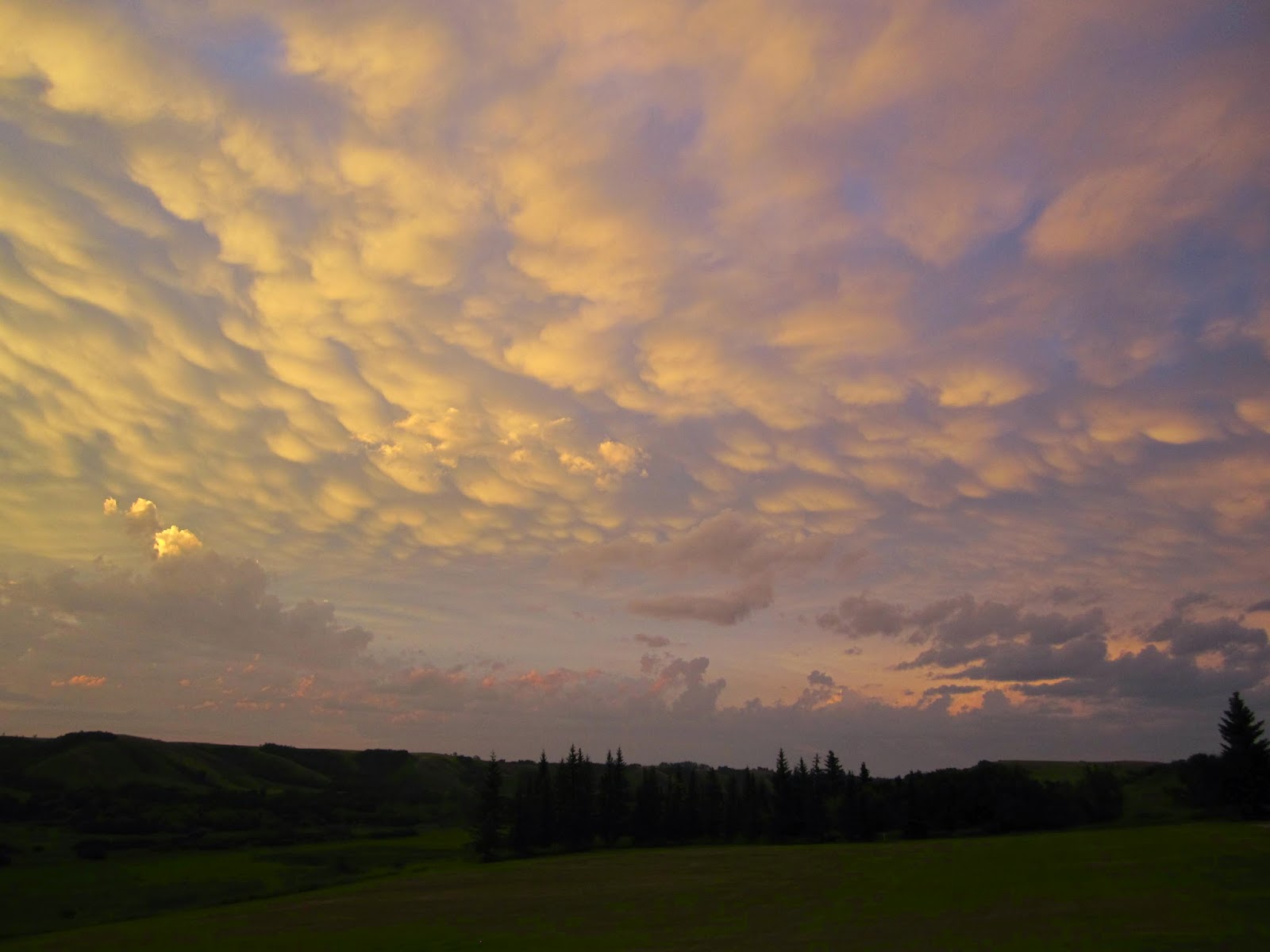
Weather literally touches us. Our skin, as you will remember from high school biology, is our body's largest organ, filled with receptors. Humid air touches us differently than dry air. A breeze touches our skin lightly, while air that is heavy and unmoving seems to envelope and stifle us. I had such a strangely strong reaction to the hot humid weather and whined on FB, only to find lots of sympathy from other people who were struggling with the sense of being trapped. And as anyone with headaches or arthritis will tell you, changes in air pressure or humidity affect the inside of our bodies. That day on the highway in Alberta, the sudden cold touched my skin in a way that was subtly threatening, while the drier, cooler air of the last couple of weeks makes me feel free and yet vaguely sad. As I work in the garden more this fall than I usually do, though, I'll have chances to gather new memories of the way weather touches us.
Wednesday, August 27, 2014
Saturday, August 16, 2014
Metaphor revisited
Retirement should be about doing exactly as you like, even if finding out that some of the things you like to do are a bit...odd. I've decided that I finally have the freedom and the concentration to read In Search of Lost Time, and so have gone back to the first book to pick up all the complex threads again. That's not to say that a plethora of Proust--both in terms of page numbers and the way he can worry and worry and worry a state of mind or an obsession (yes, I meant to say he obsesses even about obsessions), isn't sometimes a little much. Then I get out the short stories of Kay Boyle of Elizabeth Bowen, both of which I've been meaning to read, for a change of pace and tone. It also doesn't mean that I actually know how to read Proust, though Roger Shattuck's Proust's Way (courtesy of dear Ken Probert's library) is proving very helpful.
But I may have, in my own bumbling way, discovered something when I finished Combray last week. Marcel is anxious about his desire to be a writer--anxious that he doesn't actually have the gift that should go with the desire. This anxiety seems to nearly overwhelm him as he describes the second of the two walks his parents usually take when they are living in Combray--the Guermantes Way. This longer walk offers so much beauty that it is almost overwhelming: he could write paragraphs and paragraphs about the water lilies alone. But on some level he is realizing the the ecstasy with which the world comes to him is not enough. At one of these anxious moments, "suddenly a roof, a gleam of sunlight on a stone, the smell of a path would make me stop still, to enjoy the special pleasure that each of them gave me, and also because they appeared to be concealing, beyond what my eyes could see, something which they invited me to come and take but which despite all my efforts I never managed to discover....It was certainly not impressions of this kind that could restore the hope I had lost of succeeding one day in becoming and author and poet, for each of them was associated with some material object devoid of intellectual value and suggesting no abstract truth. But at least they gave me an unreasoning pleasure, the illusions of a sort of fecundity, and thereby distracted me from the tedium, from the sense of my own impotence which I had felt whenever I had sought a philosophic theme for some great literary work" (252).
For the next four pages, he describes his experience of the "twin steeples of Martinville, bathed in the setting sun and constantly changing their position with the movement of the carriage and the windings of the road, and then of a third steeple, that of Vieuxvicq, which, although separated from them by a hill and a valley, and rising from rather higher ground in the distance, appeared none the less to be standing by their side" (254). Two pages later, he manages to borrow a pencil and paper from the doctor with whom he is traveling and record his impressions. After describing the three steeples he observes how the turns of the road transform their relation with one another: "Sometimes one would withdraw, so that the other two might watch us for a moment still; then the road changed direction, they veered in the evening light like three three golden pivots, and vanished from my sight. But a little later, when we were close to Combray, the sun having set meanwhile, I caught sight of them for the last time, far away, and seeming no more now than three flowers painted upon the sky above the low line of the fields. They made me think, too, of three maidens in a legend, abandoned in a solitary place over which night had begun to fall; and as we drew away from then at a gallop, I could see them timidly seeking their way, and after some awkward, stumbling movements of their noble silhouettes, drawing close to one another, gliding one behind another, forming now against the still rosy sky no more than a single dusky shape, charming and resigned, and so vanishing in the night" (256).
What Marcel has discovered is, of course, metaphor. He's asking a lot of himself, at his age, to find a great philosophic theme that will infuse his work. But he can find a different--less literal--way of seeing the world that infuses it with significance. What Marcel intuits here is, of course, the fact that where you stand determines what you see; the three steeples, "golden pivots" in the setting sun, provide him with a chance to note how turns in the road, metaphorical and literal, change his view of these unchanging pivot points that nevertheless look different every moment. And as if to underline the metaphorical significance he intuits, he turns naturally to metaphor: they are flowers painted on the sky or three abandoned maidens. In Search of Lost Time is full of rich prose, but--and I'm assuming I can trust the three translators that have brought their skills to the translation--Proust tends to use far more similes than metaphors, at least in the first volume, Swan's Way. This fact makes the metaphors of his early writing stand out that much more dramatically.
In the final chapter of Metaphor, Denis Donoghue quotes Quintilian, who offers "the strongest motive for known to me...'it ensures that nothing goes without a name,'" thus adding "'to the resources of language by exchanges or borrowings to supply its deficiencies'" (182). In keeping with Donoghue's notion that metaphor confers liberty--an earlier observation that might flow from this later moment--he writes "The source of metaphor is the liberty of the mind among such words as there are. In metaphors, we cry out to change the world by giving things their proper names--which they have lacked" (183-4). There is something Adamic about metaphor, then; some moment when a turn of phrase actually turns up the real significance of something you have seen or used every day. But the naming we do when we create metaphors is world-creating, world-shifting. Forgive me if I sound like an overly-clever undergraduate for a moment, but it seems to me important that there are three steeples involved in Marcel's epiphany, two closer together and one farther away: perhaps they are themselves a metaphor. The two that are close are the tenor and the vehicle of metaphor. The vehicle, this surprising yet apt comparison, causes us to see the tenor in an entirely different way. But the whole project of metaphor, and the varied ways in which the tenor and vehicle resonate with each other like the third steeple of Marcel's vision or the strings on a well-tuned violin, produces a third thing that is almost equivalent to the philosophical project that Marcel seeks. It creates an interaction between mind and world.
The final chapter of Donoghue's book, "The Motive for Metaphor," takes its title from a poem by Wallace Stevens, whom Donoghue quotes extensively on metaphor. In a rather somber poem titled "Metaphor as Degeneration," Stevens notes that "being / Includes death and the imagination" (205). That's a world view I can live with; I do believe that our imaginations allow us all to live more fruitfully, more fully. Imagination doesn't privilege the world--as if all we live for is material; nor does it privilege solely the inner life. Imagination creates conversations with the world--even moments for world to talk back. Metaphor may give us liberty, but finally the world with its intransigence talks back and reminds us that in the face of our mortality metaphor may only express desire.
The photograph at the top of the blog was taken by Veronica Geminder in Montmartre last spring. I'm using it as the inspiration for a poem about metaphor, because it seems to me that metaphor is both a window and a stairway going unexpected places.
Thursday, August 7, 2014
Metaphor
You would not think that I needed, at the age of 64, to go to Sage Hill and work with Ken Babstock in order to learn about metaphor. In my defense, I now realize that as a teacher I spent way too much time with undergraduates simply attempting to help them identify the implied tenor (the thing or idea or action that the author is writing about) and the vehicle (the thing that replaces the tenor by way of comparison or substitution), and then trying to get them to be playful (When reading poetry? Never!) and consider the significance or the meaning of the collision of these two ways of looking at the writer's subject. This is a terrible way to do this: it makes the reading of metaphors into a kind of decoding, a kind of literary Enigma Project. Now there's a metaphor for you. (Yesterday when Bill and I were looking at new sofas, I was trying to explain to a salesman what I was looking for when I used the word "streamlined" or "minimal." I finally tried "as if the sofa isn't trying to look like an SUV." He got it. They didn't have any.)
Ken's approach is much more dramatic: for him, a good metaphor creates a kind of "explosion," a species of alchemy. His Griffin-prize-winning collection, Methodist Hatchet, signifies by its title--what makes a Methodist hatchet different from, say, a Catholic hatchet?--the way Ken will relentlessly question what language will do. The poems are full of metaphors almost too particular to their context to use as examples. What does it mean that shrikes are rhetoric's murre?--a figure from the title poem. But here's a more straightforward example from "Fending Off the Conservativism in Adorno": "bread's now a four-pound cow pat of walnut sourdough that petrifies by Wednesday." Yes, we've bought that particular sour dough, and it was indeed amazingly dry by Wednesday. But comparing walnut sourdough to a four-pound cow pat makes that fact startlingly visceral and distinctly disgusting in its pretensions to be artisanal bread.
So I came home to read Denis Donoghue's latest book, Metaphor. At 86, Donoghue is entitled to be as autobiographical as he likes to see where it takes him. It takes the scholar to his Irish Catholic upbringing before his voice turned, when he was a boy soprano, singing the hymns of Aquinas; now he is inclined to consider, through translations and close reading, what Aquinas means by "figure," a Latin term for figurative language or metaphor. While that particular line of questioning didn't resonate with me, it nevertheless made very clear that the idea of metaphor, the querying of metaphor has a very long tradition and that its history has deep roots in our sense of the sacred: Donoghue quotes Father Ong's description of metaphor as a "transubstantiation of language." Metaphor descends beneath mere play with similar appearances or rhetorical decoration to explore or instantiate a moment when our sense of the world is temporarily changed or thrown into disarray by language. Perhaps this is part of the explosion, the charge, that Ken pushed me to achieve.
Early on, Donoghue is categorical about this "transubstantiation." Thinking about his experience of reading "The Wasteland," Donoghue lands on the following lines:
A woman drew her long black hair out tight
And fiddled whisper music on those strings.
A woman combing her hair is suddenly--and eerily--transformed into a violinist playing a pianissimo passage: we can see the visual similarity if we're not too nice about it. Donoghue comments "If the lines make us imagine for a moment a different world than our own, all the better....The effect of Eliot's metaphor is to give her a new life, not by deleting the old one but by drawing a new image across it, that of a woman with long, black hair playing the fiddle. The woman has been given another life for the time being. So have I, when I read it" (2-3). In the most powerful metaphors, there is no "is" between tenor and vehicle: nothing in Eliot's lines say that the black-haired woman is also a violinist. The verb "fiddled" effects the image, slips us momentarily into another world, but in no way replaces the tenor. In this way according to Kant, metaphor shows both the mind of the writer and that of the reader using the imagination to think beyond itself (48), to consider two things in the same instant.
Donoghue also suggests that one of the experiences created by the use of metaphor is freedom for both reader and writer. One of Donoghue's most strident examples of this freedom is Milton's metaphors and similes, which were sometimes derided by his contemporaries because they "obeyed no laws." The vehicle, according to Origen, has the capacity to float free of the tenor or even to supplant it--something a strong metaphor should be able to do--other wise, it's mere decoration. Donoghue remarks that metaphors "conspire with the mind in the enjoyment of its freedom" (64). This is certainly the case for the writer who, through the conventions that govern metaphor, is free to surprise, shock, query, delight with an apt or even a comprehensible but counterintuitive metaphor that calls into question what we thought we knew about the tenor. That freedom extend to the reader who is free "to replace the given world with an imagined world of one's devising" (86). A simile allows us to see the world differently, but the "like" or "as" makes the vehicle into something else only for the time when we consider the comparison; simile is more polite and self-effacing. A metaphor, on the other hand, involves a change in the world and a change in our perception of the world.
On Wednesday, Bill and I went to Moose Jaw, partly to go to the Moose Jaw Art Gallery, which may be small, but which offers many delights, and on a scale small enough that you can mull over what you have seen. The ceramic piece at the top of the post is one of a group created by Les Manning for an exhibition called Common Opposites; it's called "Anvil/Boat." Throughout this work, Manning is juxtaposing one element of clay--its roughness, to another element of ceramic practice that makes use of glazes. If we quickly identify the bottom of the piece as the anvil, we are left wondering how the top portion represents a boat. I can't help feeling as if the piece as a whole operates as a metaphor for all kinds of oppositions, like open and closed, protected and vulnerable. In literal terms, the "anvil" portion of the work is not really very anvil-like: I don't think a piece of clay would make a good surface for beating out the shape of a piece of armour, for example. It would fracture under the first blow. So what exactly is an anvil or a boat? These visual forms are almost vehicles for tenors implied by the words in the title that Manning gives his work, and as such they ask all kinds of questions about how we conceive of anvils and boats--besides noting their playful juxtaposition. Directly above is an installation by Judy McNaughton called "Lamb's Tales." She is honest about the metaphoric side of her work, noting that while the decision to cast all these delightful lambs came from helping her brother at lambing time, the "implications are metaphoric: the thin threshold between life and death and how this parallels other transitional states."
I'm not done with metaphor. I still have four more chapters of Donoghue's work to read. As well, he's made me a little more aware of the many ways we can create metaphors besides saying "this is that." We can use verbs, as Eliot has done above. We can let the metaphor remain on the level of comparison implied by "this is that," or we can find a more interesting way of getting the two images to interpenetrate each other and shift the very ground the reader stands on. As well, I'm finding myself curious about the metaphors in Proust's Remembrance of Lost Time, which I've begun again with the intention of getting all the way through this time. In the twenty-first century, one would be inclined to call the work ill-shaped, with too little scene and a plethora of summary, yet I find the work seductive. In part, I keep looking for those moments when the narrator's endless reflections stumble onto some recognition, some statement about the human condition that is completely surprising. Other times, I think I'm reading metaphor to metaphor--and enjoying every moment in between.
Care to share your favourite metaphor in the comments section?
Saturday, July 26, 2014
Voices
Last spring, when I was teaching Esi Edugyan's remarkable Half Blood Blues, I found myself asking my students an off-kilter but strangely crucial question. The novel's narrator, Syd, has to choose, he believes, between "getting the girl" and laying down a track of remarkable jazz--an apparent choice that leads to many ethical dilemmas. I asked how many of them would be willing to spend the rest of their live without love. Since they were in their early twenties, an eternity without love yawned before them, and they could understand the profundity of his dilemma. Then I asked if they'd be willing to spend the rest of their lives without a voice that was heard and believed credible. The room went startlingly silent as they imagined themselves faced with a future nearly as painful as living without love. Bless them: they proved something I've long believed: that our need to have a voice is nearly as integral to our sense of well-being as our need to be loved by someone who sees us as we are and loves what she or he sees.
More recently, reading All My Puny Sorrows made me think about voice. I always tell my creative writing students that the right voice is the foundation of almost anything we write; frequently I make them rewrite the opening to a story or a couple of stanzas of a poem in a different voice--to shift from first person to third, or third to first. As writers, we can get into habits that seem merely technical preferences that turn out to have a profound effect on how we see or represent the world we are creating. But Miriam Toews' novel makes so clear what can happen if you find the right voice--the right tone and perspective--to tell a story. I suppose she could have used an omniscient narrator, but Yoli's slightly manic, disorderly, casual but loving voice provides the crucial counterweight to her serious artistic sister's decision to commit suicide. The novel would have been either unbearable or pompous and stodgy told any other way.
I finished the novel on the same day that I undertook a massive revision of one of the poems I'd been finding slight and insubstantial, a poem that said "Cool! There's a Rothko in a back lane in downtown Saskatoon" and not much more. There was more to be gotten, and I certainly found the "more" when I slowed myself down to the pace of considered revision (rather than trying to keep up the pace of fevered composition). I found the similarities between how the world around us changes constantly and how for some people forgetting is a kind of forced, speeded-up change. Here were my final lines about the young woman who paints over the door to create the Rothko and her father, who has dementia:
In the untroubled silence between them
she’ll wonder how to tell change
from forgetting
except to think of doorways
and the words we write on them.
Okay, I've come to some metaphysical conclusions--or at least the statement of a metaphysical problem--but the whole poem was so stodgy. When I went to bed that night, Toews' novel threaded through my thoughts, and I realized that I needed to use the first person. Here's the opening in the new version:
What does a Fine Arts
student know about business,
except maybe the difference
between what’s good and what sells?
So the insurance guy comes and says
the back door is all wrong. The sidelight
breaks in two seconds and the perp
reaches in and unlocks my deadbolt
in a trice. Also, don’t put your name
on the door back here: keep ‘em
guessing. He’s looked at my prices
but hasn’t thought about how someone
hungry for high or oblivion
can fence a Benjamin Chi Chi repro
or an owl by Josie Iaqluk
on a Saskatoon street corner.
The new voice brought a new sensibility into play, one who could think about perps and business. Whew! She had enough spirit to save the poem. Once she got around to the problem of her father, we might have a better sense that the profound question she's asking is one that most of us face at one time or another.
One of the traditions of Sage Hill is two nights of student readings. We're kept to a tight schedule--five minutes. Finding the right five minutes in your manuscript is an excellent exercise for finding a moment of weight and significance. Then we introduce the next writer.
I've long been in awe of the fact that composers can work with a limited palette of tones and rhythms and create music that differs not only in melody and harmony, but in its expression of a frame of mind, a world view, an emotion, attitude, experience. Night before last, half the students read and I experienced a similar awe: we all have a similar set of vocal chords, and students at Sage Hill represent a paradoxically idiosyncratic and yet homogeneous part of the Canadian population. We worry about the same kind of human challenges, though from different angles and temperaments, but our expression is often as singular as the voice our lover recognizes, even when the phone connection is bad.
I'll bet each one of you has sometimes opened a book you've taken from the shelves of a library or a bookstore, read a couple of paragraphs, and put it back. Somehow this voice doesn't speak to you, or you don't quite trust its view of the world. Stories are integral to who we are. The well-told story enchants, enthralls, grabs you by the throat, as Lawrence Hill did in his reading last night. There is something ineffable about the well-told story: it's one of those moments when vision--the sense of which stories are important and the knowledge of why this story is important--and craftsmanship--the knowledge of the story's structure, the ability to get a character to rise off a page--come together in a fusion that reaches right off the page. But I wonder how many of us must first find a smaller pearl: the right voice. A voice that's made of vocabulary, syntax, world view; a voice that speaks a historical moment and a place in society. Voices themselves are windows or doorways into new perspectives, new rhythms of thought. The more voices that rattle around in our heads, the richer our sense of the world.
Subscribe to:
Posts (Atom)